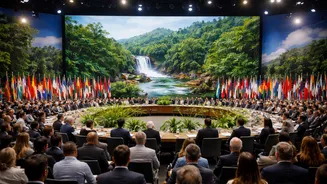








More than 150 countries have endorsed a landmark global report warning that the world’s heavy reliance on economic growth measured by gross domestic product
(GDP) is accelerating damage to nature and biodiversity. The report, released on Monday, argues that businesses and governments continue to undermine ecosystems despite their dependence on nature for essential resources and services such as clean water, pollination, climate regulation, and soil fertility. It concludes that the global economic system fails to properly account for the risks and costs associated with biodiversity loss, said a Bloomberg report. Compiled over three years by nearly 80 scientists and industry experts, the study is intended to guide future investment decisions and shape national policy frameworks. Its findings were formally approved by researchers and government representatives at the latest summit of the Intergovernmental Platform on Biodiversity and Ecosystem Services (IPBES), which concluded on Sunday in Manchester, United Kingdom. According to the report, nature is deteriorating worldwide at an alarming pace. Levels of “natural capital” — a term that includes ecosystems, wildlife, forests, rivers, and other natural resources — have declined by almost 40%. Because biodiversity loss is largely absent from market pricing, companies rarely bear the true cost of environmental damage, leaving little financial incentive to protect or restore nature. Scientists and environmental groups have long maintained that safeguarding biodiversity also reduces economic risks, including those linked to extreme heat, flooding, food insecurity, and the loss of plants and animals critical to medicine and agriculture. Despite this, investment patterns continue to favor environmentally harmful activities. In 2023, an estimated $7.3 trillion was directed toward “nature-negative” sectors, while only about $220 billion went into projects that benefit ecosystems, according to the United Nations’ State of Finance for Nature report. “Too often, what is profitable for business is harmful to nature, and what benefits nature struggles to attract investment,” said Stephen Polasky, a professor of environmental economics at the University of Minnesota and co-chair of the report. Speaking at a press conference, he stressed that voluntary action alone is insufficient and that economic incentives must be redesigned to reward nature-positive outcomes. The conference was opened last week by the UK’s environment minister, Emma Reynolds, who read a message from King Charles urging nations to move toward an economic model that allows prosperity while preserving the natural world. IPBES plays a role for biodiversity similar to that of the Intergovernmental Panel on Climate Change (IPCC) for climate science, producing comprehensive assessments every few years to inform policymakers. The United States, however, announced last month that it would withdraw from both IPBES and IPCC processes, raising concerns among scientists about future global cooperation on environmental risks. The report’s central message is clear: without rethinking how economic success is measured and rewarded, continued GDP-driven growth risks further eroding the natural systems on which economies — and societies — ultimately depend.