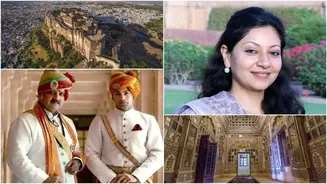

Perched on a rugged hill that scrapes the desert sky, Mehrangarh Fort watches over the indigo labyrinth of Jodhpur like a sandstone sentinel. For over five
centuries, this fort has been the heart of the Rathore dynasty, a Rajput clan famed for its military ferocity, opulent zenanas, diplomatic manoeuvring during the British era, and royal weddings that made the desert bloom with splendour. Today, their story is carried forward by modern princes who uphold a legacy woven with turbans, traditions and timeless desert pride.
Origins of the Rathores: From Kannauj to Marwar
The Rathores trace their lineage to the ancient rulers of Kannauj, one of medieval India’s most prestigious royal seats. After Kannauj fell in the 12th century, surviving Rathore nobles migrated west into Rajasthan’s harsh desert plains and gradually carved out the kingdom of Marwar. Their most influential early ruler, Rao Jodha, founded Jodhpur in 1459 and laid the foundation stone of Mehrangarh—literally, the “Fort of the Sun”.
Trivia: The name “Marwar” comes from “Maru”—meaning desert—an apt title for a kingdom that thrived on resilience, horse-back warfare and desert diplomacy.
Mehrangarh Fort: The Desert Citadel of Power and Poetry
Emerging out of a 125-metre hill of weathered rock, Mehrangarh is one of India’s greatest forts—massive, theatrical and almost intimidating in its scale. Over the centuries, rulers like Rao Maldeo, Maharaja Jaswant Singh and Maharaja Ajit Singh expanded its walls, carved new palaces and filled the zenanas with artistic marvels.
Palaces Within the Fort
Inside Mehrangarh lie architectural jewels:
Moti Mahal (Pearl Palace): The durbar hall where the Maharaja held court under ceilings sprinkled with gold leaf.
Phool Mahal (Flower Palace): Designed for dance and poetry gatherings, dripping with gilded fretwork and mirrored ornamentation.
Zenana Deodi: A private world of perforated jharokhas, hidden corridors, and women whose political influence often stretched far beyond the palace walls.
A Living Museum
Under the stewardship of the royal family, Mehrangarh today houses:
- one of India’s finest armoury collections, with exquisitely inlaid swords, Mughal shields and Rajput war armour,
- rare palanquins, elephant howdahs and turban styles preserved for public study, and
- manuscripts, artefacts and textiles that chronicle six centuries of Marwari culture.
Fact: Rudyard Kipling described Mehrangarh as “the work of giants and angels”.
The Blue City: Why Jodhpur Turned Indigo
The sea of blue houses around the fort is not a mere aesthetic flourish. Traditionally, many Brahmin households painted their homes neela, both as a mark of identity and as a practical way to repel heat and termites. Over time, the custom spread to other communities, transforming Jodhpur into one of the world’s most visually iconic cities.
British-Era Political Battles: Diplomacy on Desert Terms
During the British Raj, the Rathores navigated a complex balance between loyalty, autonomy and courtroom diplomacy.
Marwar Under British Influence
After the Treaty of 1818, Jodhpur became a princely state under British paramountcy. Yet the Rathores retained considerable internal independence. Several rulers became known for their political acuity:
Maharaja Man Singh (r. 1803–1843): Initially resisted treaty provisions but eventually stabilised the kingdom through careful British engagement.
Maharaja Takht Singh (r. 1843–1873): Strengthened the administration and worked with British officers to modernise civic systems.
Maharaja Jaswant Singh II (r. 1873–1895): A reformist ruler who built railways, courts and schools—laying the groundwork for a modern state.
The Velvety Politics of the Zenana
The zenana was not merely domestic—it was political. Royal women, including queens like Maharani Devkumari and later Maharani Krishna Kumari, often exercised subtle influence over succession disputes, diplomacy, and alliances with neighbouring houses.
Opulence and Royal Lifestyle: The Grandeur of Desert Aristocracy
Life inside the Rathore palaces radiated an aesthetic of martial elegance and desert decadence.
- Lavish Ceremonies and Weddings
- Jodhpur’s royal weddings were legendary—multi-day spectacles involving:
- processions of caparisoned horses and elephants,
- folk musicians from the Manganiyar and Langa traditions,
- royal feasts featuring saffron-rich pulaos, junglee maas, and desserts perfumed with cardamom and dried rose, and
- elaborate turban ceremonies signifying the transfer of honour and lineage.
Even in the 20th century, Jodhpur weddings continued to draw royalty, statesmen and global social elites.
Lifestyle Inside Umaid Bhawan Palace
The modern seat of the family, Umaid Bhawan Palace, was commissioned by Maharaja Umaid Singh in 1929 as a famine-relief project that employed thousands of Marwari workers. Completed in 1943, this golden-sandstone palace remains:
- one of the world’s largest private residences,
- a hybrid of Indo-Deco and classical design,
- home to a private museum, royal residences, and the Taj-operated luxury hotel.
Trivia: The palace contains over 347 rooms and was designed by British architect Henry Vaughan Lanchester.
Maharaja Hanwant Singh: Glamour, Horses and a Tragic End
One of Jodhpur’s most charismatic rulers, Maharaja Hanwant Singh (1923–1952), was revered as a skilled horseman, moderniser and patron of polo. His sudden death in a mysterious air crash in 1952 ended a colourful era of princely glamour.
His wife, Maharani Krishna Kumari, later emerged as a respected Member of Parliament—an example of the growing public roles royal women came to occupy after Independence.
The Modern Royal Family: Preserving Heritage in a Changing India
After the abolition of privy purses in 1971, many royal families struggled to maintain their estates, but the Jodhpur Royals chose reinvention over decline.
Maharaja Gaj Singh II: The Architect of Heritage Revival
Born in 1948, Maharaja Gaj Singh II, popularly known as Bapji, has been central to Jodhpur’s cultural renaissance. Educated in England and a former Member of Parliament, he transformed Mehrangarh into a world-class cultural heritage institution.
His initiatives include:
- founding the Mehrangarh Museum Trust, regarded as one of India’s best-managed heritage bodies,
- restoring forts, cenotaphs and collections with scholarly precision,
- hosting the globally acclaimed Rajasthan International Folk Festival (RIFF) and World Sacred Spirit Festival, and
- pioneering research on Rajput arms, textiles and turban traditions.
The Young Generation: Shivraj Singh and Princesses
The legacy continues through:
Yuvraj Shivraj Singh, heir to the Jodhpur title, a world-ranked polo player and active custodian of Marwari equestrian heritage.
Princess Shivranjani Rajye, who oversees conservation, female artisanship programmes and museum outreach.
Princess Chitrangada Rajye, known for cultural diplomacy and philanthropy.
Fact: The Jodhpur royal family still upholds turban-tying traditions that vary by occasion—weddings, coronations, festivals and diplomatic meetings each have distinct styles and colours.
Other Forts and Palaces of the Rathores
While Mehrangarh dominates the skyline, the Rathores’ architectural stamp is visible across Marwar.
Mandore Gardens
Once the capital before Jodhpur, Mandore is home to cenotaphs, rock-cut temples and a hall of heroes honouring Marwar’s folk warriors.
Rao Jodha Desert Rock Park
Created to restore the natural ecology around Mehrangarh, the park today protects volcanic rock formations and indigenous desert flora.
Umaid Bhawan Palace Museum
The museum exhibits rare clocks, royal portraits, arms and the hall where coronations were once held.
Legacy of Honour, Architecture and Desert Identity
The Rathores’ enduring legacy lies in their blend of martial valour and artistic refinement. They fought with swords yet built palaces dripping with delicate filigree; they struck treaties with the British yet retained fierce Rajput pride; they hosted grand weddings yet treated hospitality as a sacred duty. Their forts and palaces stand not just as architectural wonders but as embodiments of Marwari identity—sunlit, stoic and magnificently resilient.
Even today, as Jodhpur becomes a global destination for culture, polo and heritage tourism, the royal family’s presence ensures that the city does not merely live on its past: it inhabits it.
Mehrangarh’s ramparts continue to echo with the sounds of history—hoofbeats, drums, royal proclamations and the whispered songs of desert winds. The Rathores of Jodhpur forged a kingdom not only of stone but of spirit. Their modern heirs preserve this inheritance with the same dignity their ancestors carried into battle: heads high, turbans crowned, and legacy secure.