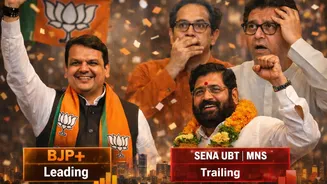







BMC polls 2026: As counting continues in Maharashtra’s civic body elections, the trends speak volumes. The early edge for the Devendra Fadnavis-led Mahayuti
(BJP + Shiv Sena (Shinde)) from Mumbai’s Brihanmumbai Municipal Corporation (BMC) seems more like a political statement and a message for the Thackerays – Mumbai has moved on, at least it seems so if trends translate into results later in the evening. The BJP-led alliance is ahead in 118 BMC wards; BJP leading in 89 and the Shinde faction in 29. Ajit Pawar's NCP (AP) is ahead on just three wards. The Thackeray brothers – Uddhav Thackeray’s Shiv Sena (UBT) and Raj Thackeray’s MNS - are ahead in 77 wards. Health warning: The numbers may still change as counting progresses. The trends, however, show the mood and that is unmistakable: the Bharatiya Janata Party is emerging as a ‘senior partner’, shrugging off the “junior partner” tag given by Uddhav Thackeray-led Shiv Sena. Mumbai BMC Election Results 2026 Live The win at BMC will matter – not just to Mumbai but to Maharashtra and beyond. The BMC is not just another municipal body; it has an annual budget exceeding Rs 74,400 crore. It is Asia’s richest civic body and the financial, administrative, and symbolic heart of Mumbai. Control of the BMC has historically meant political edge beyond potholes and drains—it shapes urban contracts, deep on-the-ground networks, and the strong political presence in Assembly and Lok Sabha elections. The Mumbai civic polls, which were to happen in 2022, are being conducted after a delay of three years. But for decades, Shiv Sena - the undivided one - ruled the municipal corporation. Even when the BJP spread its wings in Maharashtra, Mumbai remained Sena’s emotional and organisational fortress. In 2017, a united Shiv Sena still managed to retain control of the BMC despite a strong BJP push. That legacy, the emotional quotient, and an apparent rejection by ‘Aamchi Mumbai’ and ‘Aamchi Mumbaikars’ are what make the current numbers uncomfortable for the Thackerays. What appears to be playing out now is not just one rejection in one of the polls; it seems like a reorganisation of political confidence. Mumbai has moved on from emotional pitches to development goals. The BJP’s campaign leaned heavily on governance messaging, local ward arithmetic, and alliance consolidation. The Shinde faction’s presence has further complicated the traditional Sena voter base, particularly in working-class and Marathi-speaking pockets where organisational loyalty once flowed in a single direction. The Thackerays combined, and the Shiv Sena (UBT) is fighting beyond BMC polls — not one of numbers alone, but of identity, continuity, and legacy. Their argument is a mix of emotions and politics at once: that their legitimacy, their hold over the city, cannot be sliced by court orders or realignments on paper. The party's soul cannot be divided. But civic elections are rarely sentimental. They are brutally practical with shocking results, in most cases. They reward who shows up, who controls the booth, who can knock on doors year after year — not just when Assembly or Lok Sabha campaigns turn loud and dramatic. For the longest time, the undivided Sena was ‘family’; they rode the “Marathi Manush” wave, but that EQ is apparently fading. And that raises an uncomfortable question for the Thackerays: can legacy alone still hold the city together, or does Mumbai now demand something more organisational, more relentless, more everyday? The Shiv Sena (UBT)’s partnership with the Congress may have been politically necessary at the state level, but it may have cost the Thackerays in Mumbai civic polls. The BMC has long been contested on identity, pride and the Marathi factor, but sharing space with the Congress appears to have blurred that clarity. What the trends seem to suggest is not a rejection of the Thackerays, but something more complicated — fragmentation. With the Marathi vote now split between Uddhav Thackeray’s Shiv Sena (UBT), Raj Thackeray’s MNS, and the Shinde-led Shiv Sena, the once-monolithic political identity that defined Mumbai’s civic politics no longer moves as one block. When loyalty fractures, even slightly, arithmetic begins to matter more than emotion. In a civic election spread across 227 seats, with nearly 1,700 candidates in the fray, even a handful of votes shifting ward by ward can change outcomes. Zoom out further, and the Maharashtra-wide picture only sharpens this moment. Across 29 municipal corporations, the BJP is leading in 736 wards, with the Shinde-led Shiv Sena adding another 218. Congress follows at 194, while the Shiv Sena (UBT) lags at 93, Raj Thackeray’s MNS at 10; Ajit Pawar’s NCP at 110; and Shard Pawar’s party at 10. These are not just numbers — they are signals. For years, civic politics was treated as local, transactional, almost secondary. Today, it has become the laboratory where post-split power equations are being tested in real time. Who owns the ground? Who controls the cadre? Who survives not on slogans, but on systems? The BMC, in that sense, is no longer just Mumbai’s municipal corporation. It is a mirror held up to every party in Maharashtra, reflecting hard truths about reach, relevance, and not banking on caste and legacy alone. And as counting continues, one question quietly hangs in the air: is this just an early trend, or the beginning of a longer political reordering in Mumbai? Mumbai and Pune, in particular, have turned into parallel prestige battles. In Pune, despite a rare coming together of rival NCP factions led by Ajit Pawar and Sharad Pawar, the BJP is leading comfortably with 80 seats out of 165 seats; the combined NCP factions are leading on just 9 seats. The message is clear – the development pitch is penetrating deep into Maharashtra. The result is still not out, and so is the verdict on Mumbai or Maharashtra. Counting is still on, edges are shifting, and civic elections are known for last-minute turnarounds. The history of BMC polls has witnessed many such ‘oh no’ and ‘oh wow’ moments. Still, the symbolism is hard to ignore. For the Thackerays, Pawars, and the BJP. In that sense, these civic polls are less about who controls ward offices and more about who owns Mumbai’s political future. The verdict, when it fully arrives, may not be absolute—but its message will be.