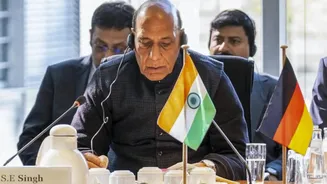







India may play a larger role in bringing peace to the West Asia ravaged by the US-Israel-Iran war, indicated Union Defence Minister Rajnath Singh; however,
he stopped short of mentioning the word 'mediation'. "India has tried... But everything has its time. It is possible that tomorrow, the time may come when India plays its role in this and achieves success as well. We cannot rule out this possibility. The Prime Minister has appealed to both sides to end the war. Our Prime Minister has a very balanced approach to diplomatic matters," said Rajnath Singh when asked if India has any role to play in initiating peace amid the West Asia crisis, as quoted by ANI. Singh highlighted India’s balanced diplomatic approach, noting that Prime Minister Narendra Modi has engaged with multiple global leaders — including Vladimir Putin and Donald Trump — to push for a peaceful resolution. "When he (PM Modi) met Russian President Putin and the Ukrainian President, he discussed this. Even when he met Trump, he also discussed and said that a solution should be found..." he said.
#WATCH | Berlin, Germany: When asked if India has any role to play in initiating peace amid the West Asia crisis, Defence Minister Rajnath Singh says, "India has tried... But everything has its time. It is possible that tomorrow, the time may come when India plays its role in… pic.twitter.com/qAVdC5lXFC
— ANI (@ANI) April 22, 2026
He also cited India’s continued maritime movement through the Strait of Hormuz despite heightened tensions. Notably, multiple Indian vessels have crossed the Strait of Hormuz after the beginning of the war on February 28, with an effective Iranian blockade in place.
"The way India is moving, you must have seen that in the Strait of Hormuz, no ship from any country was able to pass through. If anyone managed to pass through their 7–8 ships, then it was India... It is not that the US considers India as its enemy, or Iran considers India as its enemy. No, this is a very balanced approach of India," he said.
The US and Israel began the war on February 28 with aerial bombardments of Iran. The conflict quickly spread to Gulf states that host US military bases and to Lebanon once the Iran-allied militant group Hezbollah joined the fighting. The hostilities ceased following the two sides agreed for a two-week truce, which was set to expire on Wednesday. Both countries had said they were prepared to resume fighting if no deal is reached.
Just before the deadline, US President Donald Trump said that he extended the ceasefire with Iran at Pakistan’s request while awaiting a "unified proposal" from Tehran. Trump said that the US military will continue its blockade of Iranian ports. There was no response early on Wednesday to Trump's announcement from senior Iranian officials, although some initial reactions from Tehran suggested Trump's comments were being treated skeptically.