






The world's nine nuclear-armed countries spent an estimated $474 billion on their nuclear weapons programmes between 2021 and 2025, with the United States
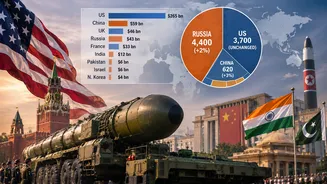
alone accounting for more than half of the total. The figures offer a measure of the financial scale of nuclear deterrence, even as separate estimates for 2026 point to continued expansion of several countries' arsenals. Data from the International Campaign to Abolish Nuclear Weapons (ICAN), presented alongside nuclear inventory estimates from the Stockholm International Peace Research Institute (SIPRI), show Washington spending $265 billion over the five-year period. China followed with $59 billion, while the United Kingdom allocated $46 billion and Russia spent $43 billion. France recorded expenditure of $33 billion, followed by India at $12 billion. Pakistan and Israel each accounted for $6 billion, while North Korea's estimated spending stood at $4 billion. The US figure is particularly striking: its nuclear weapons expenditure was more than four times China's and exceeded the combined spending of the other countries listed. However, the financial rankings tell only part of the story. The number of nuclear warheads held by each country presents a different picture of the global balance.
Russia and US account for more than 8,100 nuclear warheads
The 2026 inventory estimates place Russia at the top of the global nuclear stockpile, with approximately 4,400 warheads. The United States follows with an estimated 3,700, taking the combined Russian and American inventory to around 8,100 warheads.
Together, the two countries possess more than four-fifths of the estimated global total of 9,745 warheads. Russia's inventory increased by 2% between 2025 and 2026, while the US figure remained unchanged.
China ranks third, with an estimated 620 warheads, representing a 3% increase over the previous year. Its stockpile remains considerably smaller than those of Washington and Moscow, but the continued rise places Beijing among the nuclear powers expanding their arsenals.
The contrast between expenditure and inventory is significant. Although the United States accounts for the largest share of nuclear spending, Russia retains the world's largest estimated stockpile. Spending figures reflect investment in maintaining and modernising nuclear forces, rather than simply the number of additional warheads produced.
India records 6% increase in estimated nuclear arsenal
India's estimated nuclear stockpile rose by 6% to 190 warheads in 2026, according to the figures presented in the infographic. This places the country among the nuclear powers recording an increase in their estimated inventories.
Pakistan's stockpile, meanwhile, was estimated at 170 warheads, unchanged from 2025. The figures put the two South Asian nuclear powers relatively close in numerical terms, with India holding an estimated 20 more warheads than Pakistan.
The comparison comes against the backdrop of their longstanding strategic rivalry and reliance on nuclear deterrence. However, warhead numbers alone do not establish the relative strength of their nuclear capabilities. Delivery systems, operational readiness, survivability and command-and-control arrangements also shape the credibility of a country's nuclear deterrent.
India's estimated expenditure on nuclear weapons between 2021 and 2025 stood at $12 billion, compared with $6 billion each for Pakistan and Israel, according to ICAN's figures.
North Korea records highest percentage increase
North Korea registered the sharpest percentage rise in its estimated nuclear stockpile among the countries listed. Its inventory increased by 20% to 60 warheads in 2026, although its arsenal remains substantially smaller than those of the established nuclear powers.
The increase comes as Pyongyang continues to develop its nuclear capabilities, keeping the issue high on the security agenda for South Korea, Japan and the United States.
Elsewhere, France's estimated stockpile remained unchanged at 290 warheads, while the United Kingdom retained 225. Israel was estimated to possess 90 warheads, also unchanged from the previous year. Israel maintains a policy of nuclear ambiguity and does not officially acknowledge possessing nuclear weapons.
Nuclear investment continues despite differences in arsenal size
The figures highlight two parallel aspects of the global nuclear balance: the money countries are committing to their nuclear programmes and the size of the arsenals they maintain. The United States dominates the spending figures, Russia holds the largest estimated inventory, and China continues to expand its stockpile. India and North Korea have also recorded increases, while Pakistan's estimated numbers remain unchanged.
The distinction between the two datasets is important. ICAN's expenditure figures cover the period from 2021 to 2025, whereas the inventory estimates refer to 2026. Higher spending does not necessarily result in an immediate increase in warhead numbers, as nuclear budgets also cover maintenance, modernisation, delivery systems, infrastructure and command-and-control capabilities.
Nevertheless, the combined estimates point to the continued centrality of nuclear weapons in national security planning. With the nine nuclear-armed countries estimated to possess 9,745 warheads in 2026, the scale of their financial commitments and the expansion of several arsenals underline the enduring importance of nuclear deterrence in the global strategic landscape.