




In a sign of improving relations between Dhaka and New Delhi, Bangladesh will restore all visa operations at the Indian mission starting Monday, sources
said. All categories of visas are set to be issued again after a pause, following the assumption of charge by the new government in Dhaka. Sources indicated that India is also expected to reciprocate soon, suggesting a broader thaw in bilateral engagement. The decision marks a reversal from December, when Bangladesh halted visa services at its High Commission in New Delhi citing the “prevailing security situation.” At the time, tensions had escalated after protests near diplomatic missions in both countries. The suspension followed unrest in Bangladesh after the killing of youth leader Sharif Osman Hadi, who was shot by unidentified gunmen on December 12 and later died while undergoing treatment in Singapore. His death triggered widespread protests, some of which took on anti-India overtones.
In Bangladesh’s port city of Chattogram, stone-throwing incidents targeted the residence of the Assistant Indian High Commissioner, prompting India to suspend visa operations there from December 21. Indian visa centres in Dhaka, Rajshahi and Khulna also faced temporary closures amid security concerns, while enhanced security was deployed around missions in Sylhet.
In New Delhi, a small group of protesters gathered near the Bangladesh High Commission and shouted slogans, leading to a brief suspension of visa and consular services by the mission. Notices cited “unavoidable circumstances.”
Both governments exchanged sharp statements during the period. India summoned Bangladesh’s envoy and conveyed concern over the deteriorating security environment, saying it expected the interim administration to ensure the safety of diplomatic missions. Bangladesh, for its part, raised concerns about security arrangements for its mission in New Delhi.
Relations between the two countries had been strained since the collapse of the Sheikh Hasina government and the installation of a caretaker administration led by Muhammad Yunus. The unrest following Hadi’s death further deepened the tensions.
Tarique Rahman Sworn in As New PM
BNP leader Tarique Rahman was sworn in as Bangladesh's new prime minister, marking a new beginning for the country after 18 months of political uncertainty and lawlessness witnessed under the rule of the interim government led by Nobel Laureate Muhammad Yunus.
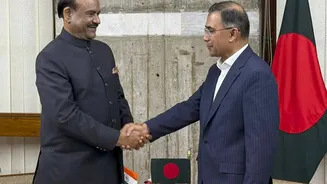
Lok Sabha Speaker Om Birla, accompanied by Foreign Secretary Vikram Misri, represented India at the oath ceremony. Birla also handed over a personal letter from Prime Minister Narendra Modi to Rahman, conveying his wishes and inviting him to visit India at the "earliest convenience".
Birla's presence at the ceremony came as Dhaka and New Delhi are looking at rebuilding their ties that came under severe strain under Yunus's interim regime.
Both leaders expressed optimism about working together for the well-being of the people of the two countries, pursuing a people-centric menu of cooperation, Bangladesh's High Commissioner to India, Riaz Hamidullah, said in a post on X.
Rahman became the prime minister for the first time. He replaced interim government chief Yunus, who took charge in August 2024 after the collapse of the Awami League regime. Rahman, the son of late President Ziaur Rahman and former premier Khaleda Zia, returned home in December after living in London in self-exile for 17 years. He will serve as the prime minister for the next five years.