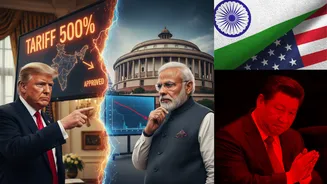









As of January 8, 2026, US President Donald Trump has renewed threats of imposing extremely high tariffs on India by backing a bipartisan sanctions bill
that could levy duties of up to 500% on Indian exports to the United States if India continues importing Russian oil. The threat is linked to India’s sustained purchase of discounted Russian crude, which has made up as much as 40% of India’s oil imports in recent years. These imports have helped India manage domestic fuel prices during periods of global energy volatility. The proposed bill is aimed at penalising countries seen as indirectly funding Russia’s war efforts through energy purchases. It would mark a sharp escalation from the 50% tariffs imposed on select Indian goods since August 2025. While the 500% tariff remains a proposal and has not yet been implemented, its potential impact could be severe, based on current trade data and past experiences with trade barriers. Current India–US Trade Landscape The United States is India’s largest export destination, accounting for about 18% of India’s total merchandise exports and playing a crucial role in India’s services trade surplus. In FY25 (April 2024–March 2025), bilateral goods and services trade reached a record $212.3 billion, an increase of over 8% compared to the previous year. India’s goods exports to the US stood at roughly $79.4 billion in 2024. Key export sectors include:
- Pharmaceuticals and drugs: Around $10–12 billion annually, making up nearly half of India’s global pharma exports
- Gems and jewellery: About $9–10 billion, supporting over 4.5 million jobs
- Textiles and apparel: Roughly $8–9 billion, a sector employing around 45 million people
- IT and business services: Services exports worth $100–120 billion, with the US absorbing nearly 60% of India’s IT exports and contributing about 8% to GDP
Overall, exports contribute nearly 18–20% to India’s GDP, with the US market directly and indirectly driving around 3–4% of annual economic growth.
India runs a goods trade deficit of roughly $46 billion with the US , which is partly offset by a large services surplus.
Potential Short-Term Impact of a 500% Tariff
A 500% tariff would effectively price Indian goods out of the US market, causing a sharp collapse in exports.
Based on the impact of existing 50% tariffs, which led to a 20–40% decline in certain exports between May and October 2025, a 500% tariff could slash India’s US exports by 80–90%. This translates into an estimated annual export loss of $60–70 billion.
Such a shock could reduce India’s GDP growth by 0.3–0.5 percentage points.
Sector-wise impact could include:
- Pharmaceuticals: Potential loss of nearly $10 billion in exports, hitting about 40% of sector output and threatening jobs in an industry employing over 2.5 million people
- Textiles and seafood: Already under pressure from earlier tariffs, further escalation could worsen job losses in labour-intensive sectors employing tens of millions
- IT services: Though not directly targeted, supply-chain disruptions and slower client spending could trim sector growth by 2–3%, affecting millions of jobs
In total, export-linked industries supporting 60–80 million jobs could see significant stress, potentially adding 2–3 million people to unemployment rolls.
Lower dollar inflows may also weaken the rupee by 5–10%, increasing import costs—especially for oil—and pushing inflation up by 1–2%.
Long-Term Effects and India’s Possible Response
Despite these risks, India’s economy has shown resilience. The country recorded 7.4% growth in FY25 despite earlier tariffs, supported by strong domestic demand that accounts for nearly 60% of GDP.
Exports rebounded sharply in late 2025 through diversification into Europe, ASEAN, and other markets. Manufacturing exports have also picked up under initiatives such as “Make in India,” reducing reliance on the US market.
India could respond with retaliatory tariffs on US goods such as agricultural products and aircraft, though this risks a broader trade war that could cost both economies billions annually.
Diplomatic channels remain open, with ongoing discussions aimed at avoiding escalation and exploring negotiated trade solutions.
If implemented, a 500% US tariff could cost India $60–70 billion in exports, shave up to half a percentage point off GDP growth, and disrupt millions of jobs in the short term. However, India’s diversified economy, strong domestic demand, and strategic export shifts may help cushion the longer-term impact.
Parallel US Tariff Threats Against China Over Russian Oil Purchases
While the Sanctioning Russia Act of 2025 has largely been discussed in the context of its potential impact on India, the proposed legislation poses identical risks for China as well. China is the world’s largest buyer of Russian crude, even ahead of India, making it a central target of the bill.
US President Donald Trump has approved advancing the bipartisan legislation, which authorises tariffs of up to 500% on imports from any country that “knowingly” purchases Russian energy products, including oil, gas, and uranium.
China, which has accounted for roughly 40–50% of Russia’s seaborne crude exports in recent years, is explicitly named alongside India and Brazil as a country that could face punitive measures. Republican Senator Lindsey Graham, a key sponsor of the bill along with Democrat Richard Blumenthal, said on January 7, 2026, that Trump had backed the move as a way to “punish” nations financing Russia’s war effort through discounted energy purchases.
These threats come against the backdrop of an already strained US –China trade relationship. Throughout 2025, the Trump administration steadily raised tariffs on Chinese goods, with effective rates climbing as high as 57.6% on certain imports by late 2025. Some sectors faced duties of up to 145%.
In October 2025, Washington and Beijing reached a temporary truce after talks between Trump and Chinese President Xi Jinping. The agreement paused triple-digit tariffs in exchange for renewed US agricultural exports to China and some relaxation of Chinese controls on rare earth exports. However, no formal, comprehensive trade deal was signed, leaving the relationship vulnerable to renewed tensions in 2026.
As with India, the legislation is still under consideration and has not yet become law. However, its potential application to China highlights a broader US strategy of using secondary sanctions to economically isolate Russia, even at the risk of escalating trade conflicts with major global economies and unsettling energy markets worldwide.