





What is the story about?
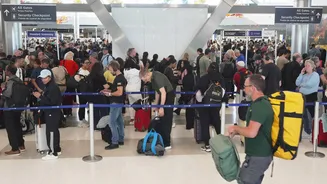
As the spring break season approaches, travelers face increased stress due to long security lines at U.S. airports. Reports indicate that some passengers
have experienced wait times exceeding one hour, with Atlanta's Hartsfield-Jackson International Airport seeing delays of up to two hours. In light of these conditions, airports in New Orleans and Austin, Texas, have advised travelers to arrive three hours before their flights. This inconsistency in wait times complicates planning for passengers, especially those accustomed to last-minute arrivals.
Factors Contributing to Delays
The current security delays are attributed to a combination of factors, including a partial government shutdown impacting Transportation Security Administration (TSA) staffing and an influx of spring break travelers. This results in fluctuating conditions that can change rapidly, even at the same airport.Given the unpredictable nature of these delays, checking TSA wait times prior to departure has become essential for airline customers.
Tracking Wait Times
During the shutdown, TSA is not actively managing its information resources, leading to potential inaccuracies in wait times reported by the MyTSA mobile app. Third-party websites that track TSA lines may also provide outdated information if they rely on publicly available data.Eric Rosen, director of travel content for The Points Guy, emphasized that major airports typically post checkpoint wait times by terminal, making them a reliable source for travelers. Monitoring airport websites and social media accounts is recommended for timely updates.
However, travelers should be aware that airport conditions can change quickly, and any posted information may not reflect real-time situations.
Advice for Travelers
Experts recommend that travelers check airport conditions frequently, as waiting until a few hours before a flight can result in limited options for dealing with delays. For instance, a 45-minute drive to the airport for a flight scheduled to leave in three hours could leave little room for error.The ongoing shutdown, which began on February 14, affects only the Department of Homeland Security, including TSA, and has left approximately 50,000 TSA agents working without pay. This financial strain has led to increased employee absences, complicating staffing levels at airports.
According to the American Federation of Government Employees, at least 366 TSA agents have resigned during this period. Rosen noted the difficulty in predicting when and where security bottlenecks may occur, as daily attendance of TSA agents varies significantly.
Planning Ahead
Tyler Hosford, a security director at International SOS, advises travelers to take a proactive approach rather than solely relying on monitoring TSA wait times. Booking earlier flights can provide more flexibility to adjust plans if necessary, whether it involves rebooking or departing from a different airport.“Under the current circumstances, having a Plan B is essential, but it may be prudent to consider Plans C, D, and E as well,” Hosford suggested.
Dealing with Long Lines
If travelers encounter long security lines upon arrival, they can seek assistance from staff at checkpoints regarding estimated wait times and available options for expedited processing.“Always communicate with airport staff; it never hurts to ask,” Hosford remarked, advising that if assistance is not forthcoming, contacting the airline for rebooking options through various channels is advisable.
“It is crucial to keep moving forward and explore available options to avoid missing a flight,” he added.