







What is the story about?
A social media post comparing board exam evaluation with AI-generated assessment has ignited debate among students over how answer sheets are checked in major
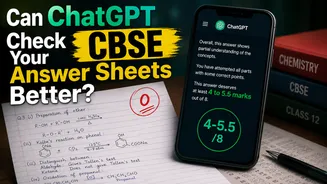
examinations like CBSE. The discussion began after a user on X shared a video of a Chemistry answer sheet and claimed that while the student received little or no marks from the evaluator, ChatGPT considered the answers worthy of partial credit. The caption of the post read, “Even AI checking is better than OSM… ChatGPT says this answer deserves at least 4 marks.”
The video, which has been widely circulated online, reportedly showed responses to an 8-mark organic chemistry question. The answers covered topics such as ether preparation, Kolbe’s reaction on phenol, distinguishing carbonyl compounds, and oxidation of propanol. While the responses appeared incomplete in parts and contained some inaccuracies, the AI chatbot reportedly assessed them as deserving around 4 to 5.5 marks because of partially correct concepts and steps.
Also check | CBSE Gives Fresh Extension for Class 12 Answer Sheet Copy Requests
The post drew reactions from students who shared similar experiences with board exam evaluation. Several users claimed they had lost marks despite writing technically correct formulas, alternate explanations, or conceptually accurate answers that did not exactly match expected wording.
One user commented, “Haha they wronged my answer because it wasn't what they wanted to see. Googled it and it was correct.”
The viral discussion has once again highlighted long-standing concerns among students about inconsistency in subjective paper checking and the lack of transparency in evaluation systems.
Board examinations such as Central Board of Secondary Education typically follow detailed marking schemes and model answers designed to ensure uniformity during evaluation. Examiners are also expected to award step-wise marks in many subjects, especially in science and mathematics papers. However, students and educators have often pointed out that interpretation can vary from evaluator to evaluator, particularly in theory-based answers.
At the same time, experts caution against treating AI tools like OpenAI’s ChatGPT as official or fully reliable evaluators. While AI systems may identify conceptual similarity and award marks for partially correct reasoning, they do not necessarily follow board-prescribed marking schemes or moderation guidelines.
The conversation has also sparked broader questions about whether technology-assisted moderation or AI-supported checking could eventually help reduce inconsistencies in subjective evaluation. However, experts maintain that any such system would still require strong human oversight, standardisation, and accountability.
For now, the viral Chemistry answer sheet has struck a chord with students across the country, many of whom say the debate is less about AI replacing teachers and more about the need for fairer and more consistent marking practices in high-stakes examinations.