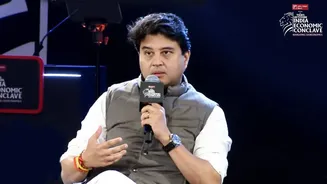

New Delhi: India’s deteriorating air quality, particularly in the Delhi-NCR region, came into focus at Times Network’s India Economic Conclave 2025, where
Union Minister for Communications and Development of the North Eastern Region Jyotiraditya M. Scindia called for scientific, long-term solutions instead of short-term fixes. Addressing the conclave, Scindia said that as India rapidly emerges as a global hub for talent and innovation, it must urgently address the recurring winter spike in Air Quality Index (AQI) levels. The two-day conclave, being held in New Delhi on December 17 and 18, has brought together Union ministers, policymakers, industry leaders and thought leaders to deliberate on India’s economic trajectory amid global geopolitical and trade disruptions, under the theme “Navigating GeoEconomics”.
“It is a problem, and it needs to be solved,” — Union Minister @JM_Scindia speaks to @Navikakumar on the pollution crisis in Delhi.@IDFCFIRSTBank @AdaniOnline #IEC2025 #INDIAECONOMICCONCLAVE pic.twitter.com/x5F4UiWGzi
— TIMES NOW (@TimesNow) December 18, 2025
‘Capital Has Become a Commodity, Talent Is in India’
Highlighting India’s growing role in the global ideas economy, the Union Minister drew a sharp contrast between capital and human talent.
“Today capital has become a commodity. The whole world is looking for new ideas, solving problems. And where is the repository of that talent? In India,” he said.
However, he stressed that the same innovation must now be channelled towards solving environmental challenges.
‘This Is the Most Dangerous Thing in Life’
Describing air pollution as one of the gravest threats to public health, the minister said the issue cannot be trivialised or postponed.
“This is the most dangerous thing in life. But whatever we have inherited, we will correct it. And we will have to do it. There is no other way,” he said.
At the same time, he cautioned against expecting immediate results, noting that air pollution is the outcome of multiple, layered and long-standing factors.
He added that the problem involves both generic and non-generic causes, requiring a combination of short-term adaptation and long-term mitigation measures.
The Union Minister emphasised that addressing pollution is no longer optional and must be tackled from multiple angles.
“What we call in the environment — adaptation and mitigation — both of those angles we will have to look at. That is not an ‘if’ issue. It has to be done,” he said.
He added that under the leadership of Prime Minister Narendra Modi, both the central and state governments would work earnestly to confront the challenge.
“We are not skirting away from any issue. It is a problem that needs to be solved for all of us,” he said.
'No Fixed Timeline'
When asked about a timeline for fixing Delhi’s air pollution, the minister said it would be inappropriate to commit to one without direct responsibility.
“I can’t answer that because I am not the environment minister nor the Delhi government. But I certainly hope that there will be a time frame,” he said.
What remains non-negotiable, he added, is a science-led approach combined with collective responsibility.
“There has to be a scientific solution. Both citizens and governments will have to take responsibility — in how we conduct our lives and in the processes that are put in place,” he said.
About Times Network’s India Economic Conclave 2025
Times Network’s India Economic Conclave 2025 is being held in New Delhi on December 17–18, bringing together Union ministers, policymakers, industry leaders and thought leaders to shape India’s economic trajectory. Against global geopolitical and trade disruptions, the conclave focuses on “Navigating GeoEconomics” and India’s role as a stabilising force on the path to Bharat 2047