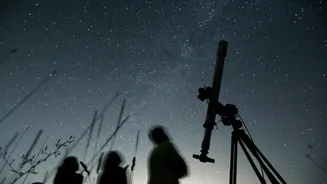
NEW YORK (AP) — At the end of February, six planets will align in the night sky, offering a spectacular view for skywatchers. This event, known as a planetary
parade, allows observers to see multiple planets without the aid of telescopes. Although the planets will not form a straight line, they will be positioned closely together on one side of the sun. This rare occurrence provides a unique opportunity for stargazers, as such alignments are infrequent.
Visibility of the Planets
On Saturday, February 24, Mercury, Venus, Jupiter, and Saturn will be visible to the naked eye, weather permitting. Uranus and Neptune, however, will require binoculars or telescopes to be seen.
Optimal Viewing Conditions
For the best viewing experience, observers should step outside about an hour after sunset. It is advisable to find an area free from tall buildings and trees that may obstruct the view. The planets will appear in the western sky, with Mercury, Venus, and Saturn near the horizon, while Jupiter will be positioned higher along with Uranus and Neptune.
Identifying the Planets
Planetary scientist Sara Mazrouei from Humber Polytechnic in Canada advises that a simple way to distinguish between stars and planets is to observe their twinkling. “If it’s twinkling, it’s a star. If it is not twinkling, it’s a planet,” she stated.
Duration of the Parade
The planetary parade will be visible throughout the weekend and in the days following. Eventually, Mercury will disappear from view as it dips below the horizon.
Connection to Historical Astronomy
Planetary scientist Emily Elizondo from Michigan State University notes that witnessing multiple planets in the sky can evoke a sense of connection to ancient astronomers. “They made sense of the universe just by looking up at the stars and the planets, which is something that we can do today,” she remarked.