



Jawaharlal Nehru, India’s first Prime Minister, delivered his famous Tryst with Destiny speech on the eve of Independence, on 14 August 1947. As the clock
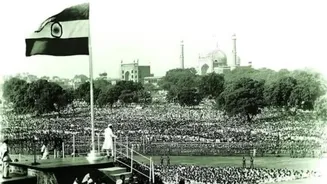
moved towards midnight, Nehru spoke of a promise finally being fulfilled, telling the nation: “Long years ago we made a tryst with destiny, and now the time comes when we shall redeem our pledge, not wholly or in full measure, but very substantially.” He went on to describe the moment when, “at the stroke of the midnight hour, when the world sleeps, India will awake to life and freedom.” But for a country that had just emerged from colonial rule, the first Independence Day was very different from the grand celebrations we know today. There was no elaborate flag-hoisting ceremony at the historic Red Fort on 15 August 1947. Instead, the national flag was first unfurled over the Red Fort on 16 August 1947. Independence meant something very different to everyone in the year 1947. India had gained freedom, but Partition had also brought violence, communal riots and bloodshed to large parts of the country. The celebrations, therefore, unfolded against a deeply complicated and painful backdrop. Fauji Akhbar, now known as Sainik Samachar, India’s oldest defence journal, which has been published since 1909, captured the mood in its special edition dated 30 August 1947. According to the publication, Delhi was filled with excitement on the morning of Independence Day. Crowds poured into the city, gathering outside the Constituent Assembly and later at Princes’ Park, where they cheered the leaders and soldiers gathered for the celebrations. Read More: Why Pakistan Celebrates Independence Day Before India? The Surprising History Behind The One-Day Gap The crowds were described as happy and good-humoured, breaking through the relatively thin police cordons and surrounding the detachments of armed forces assembled as guards of honour. Pandit Nehru and Lord Mountbatten were met with thunderous cheers. There had been plans for spontaneous ceremonies across the city, although some were eventually abandoned. The celebrations also reflected the complicated political reality of the moment. As crowds cheered Mahatma Gandhi and Pandit Nehru, cries of “Mountbatten Zindabad” and “Lord Sahib Zindabad” could also be heard as Lord Mountbatten, the Governor-General of the newly independent India, travelled through the streets in his state coach. The formal transfer of power took place at Government House, now known as Rashtrapati Bhavan. The swearing-in ceremony was presided over by Sir Justice Kania, Chief Justice of the Federal Court, who administered the oath to Mountbatten. The Governor-General then swore in his ministers one by one, beginning with Nehru. Jagjivan Ram was the only minister absent, having been hospitalised after a recent plane crash. Yet even this solemn ceremony carried the weight of history. India was now independent, and Mountbatten was no longer the Viceroy. He was the country’s first Governor-General. But the ties to the British Crown had not disappeared overnight. Mountbatten still delivered the King’s speech, while the ceremony itself retained many of the formalities of the colonial era. According to Fauji Akhbar, it was only after Lord Mountbatten’s signal that the national flag was raised over the dome of the building. The publication described the moment: “Lord Mountbatten brought the House to their feet as the first of a salvo of 31 minute guns heralded the appearance of the flag to those outside.” When Mountbatten and his wife, Edwina, left the Assembly building, the cheers grew even louder. Nehru had stepped out onto the terrace to watch the Governor-General’s departure. Mountbatten looked up, waved to the Prime Minister and saluted the Indian flag now flying above the building. But one of the most important figures of India’s freedom struggle was missing from the celebrations in Delhi. Mahatma Gandhi was in Calcutta, now Kolkata, where he was trying to quell communal violence in the aftermath of Partition. While Delhi celebrated Independence, Bengal was still burning. Gandhi had reached Sodepur on 9 August 1947 and later travelled towards Noakhali, where some of the worst post-Partition communal violence had taken place. For Gandhi, the birth of independent India was therefore not a moment for celebration. It was a moment to be spent among those caught in the violence, trying to restore peace in a country that had won its freedom at an enormous human cost.