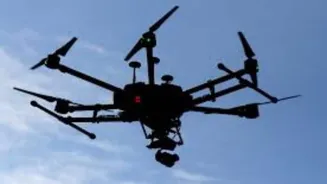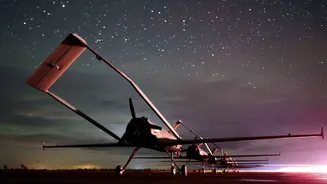









For decades, military power was measured in aircraft carriers, fighter jets and tanks. But after watching battlefields from Ukraine to the Middle East,
Pentagon planners are increasingly asking a different question: what if the future belongs to drones that cost less than a family car? That shift in thinking is driving one of the most ambitious military experiments in recent US history. According to a report by the Washington Post, the Pentagon is moving beyond traditional defence contractors and turning to startups, drone racers and technology entrepreneurs as it races to build a vast fleet of low-cost combat drones. The goal is simple but transformative: overwhelm adversaries not with a handful of expensive platforms, but with thousands of smart, expendable flying weapons.
Lessons From Ukraine And The Middle East
The Russia-Ukraine war fundamentally altered military thinking about drone warfare. Cheap first-person-view (FPV) drones costing only a few thousand dollars have repeatedly destroyed tanks, artillery systems and armoured vehicles worth millions. Similar trends have emerged across the Middle East, where relatively inexpensive drones have challenged some of the world's most sophisticated air defence networks.
Military planners have concluded that future wars may be decided less by a country's ability to build the most advanced fighter aircraft and more by its capacity to deploy drones at scale. A $100 million fighter jet can destroy targets. But so can dozens—or even hundreds—of coordinated drones costing a fraction of that amount.
Pentagon's $54 Billion Drone Gamble
To accelerate development, the Pentagon launched an 18-month programme known as "Drone Dominance". The initiative is offering companies access to $1.1 billion in contracts aimed at producing up to 300,000 drones. But that may only be the beginning. The Trump administration has proposed a staggering $54.6 billion investment in next year's defence budget to rapidly expand America's drone warfare capabilities.
The objective is not simply to acquire more drones. It is to create an entirely new military ecosystem capable of rapidly innovating and producing combat systems at a pace that traditional defence procurement rarely achieves.
Startups Replace Defence Giants
Perhaps the most striking aspect of the programme is who is competing. Instead of relying exclusively on established defence giants, the Pentagon is evaluating companies that emerged from unconventional backgrounds. One contender, Neros, was founded by former drone racing champion Soren Monroe-Anderson.
Another leading competitor, Skycutter, has partnered with Ukrainian manufacturers whose technology has been tested in real combat conditions against Russian forces. Many of these firms began as garage projects, hobby ventures or commercial drone businesses before finding themselves at the centre of America's next-generation military strategy.
The Rise Of Disposable Warfare
The drones being tested are designed with a very different philosophy from traditional military platforms. Most cost around $5,000 and are considered expendable. Rather than protecting each asset at all costs, commanders can afford to lose hundreds of them if necessary.
Inspired by drone-racing technology, these systems can fly at high speeds, navigate complex terrain and strike targets with remarkable accuracy. Some are designed for long-range attacks, while others specialise in flying through buildings, trenches and urban environments. The idea is to create swarms capable of overwhelming enemy defences through sheer numbers and persistence.