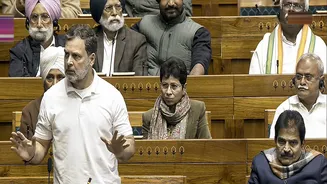






Leader of Opposition Rahul Gandhi’s reference from Former Chief of Army Staff General M M Naravane (Retd)'s unpublished memoir about China troop movement
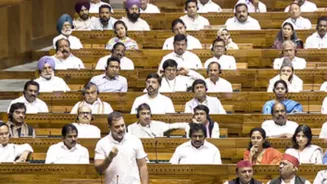
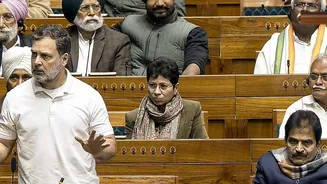
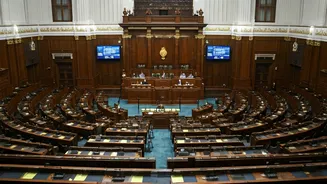
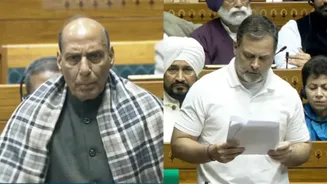
in 2020 standoff sparked a political row in Parliament on Monday, leading to repeated disruptions in the Lok Sabha. Citing House rules, Union Ministers Rajnath Singh, Amit Shah, and Kiren Rijiju objected to Gandhi reading from an unreleased book, taking action on which Speaker Om Birla invoked Rule 349(i) of the Rules of Procedure and Conduct of Business in the Lok Sabha and directed Gandhi not to quote from a purported extract of the book. However, Gandhi continued to refer to both the memoir, Four Stars of Destiny, and a Caravan magazine article based on it, leading to sharp exchanges with members of the Treasury benches. At one point, Parliamentary Affairs Minister Rijiju said the House should also deliberate on how to deal with members who defy the Chair’s ruling. While Gandhi argued that his reference to the book and its contents was linked to the President’s Address and was in response to BJP MP Tejasvi Surya’s allegations questioning the Congress’s patriotism, senior ministers maintained that he could not quote from a magazine article or an unpublished book. Also Read | Rahul Gandhi's 'Himalayan Blunder' in Lok Sabha: What’s in the Unpublished Army Chief Memoir? “This is from the memoirs of Army Chief Naravane… you will understand who is patriotic and who is not,” Gandhi said, before trying to read excerpts related to the 2020 military standoff between India and China.
What Rule 349 say?
Rule 349 of the Lok Sabha rules states that while the House is sitting, “a member shall not read any book, newspaper or letter except in connection with the business of the House.” However, the rule does not distinguish between published or unpublished material.Prior to the Om Birla’s ruling, Defence Minister and Home Minister objected to Gandhi quoting from General Naravane’s unpublished memoir, demanding to know if the book had been published. Singh later said, as defence minister, he could confirm the book was unpublished.
Also Read | 'China Will Not Forget June 16': A Galwan Warning India's Army Chief Had Issued
In this connection, speaker's ask to not read from book was for the simple argument of authentication and to ensure accuracy, particularly on issues of national security.
As Birla explained that Gandhi needed to “authenticate” what he was reading. When Gandhi said it was “100% authentic,” Singh again asked whether the book had been published. “I just want him to clarify,” Singh said, before asserting that the book had not been published at all. Shah added, “Magazines can write anything… he is saying the book has not been published. If the book has not been published, how can it be quoted?”
What Rule 353 say?
Another rule of Rules of Procedure and Conduct of Business in the Lok Sabha, invoked on Monday was that of Rule 353, which says that “No allegation of a defamatory or incriminatory nature shall be made by a member against any person unless the member has given [adequate advance notice] to the Speaker and also to the Minister concerned so that the Minister may be able to make an investigation into the matter for the purpose of a reply: Provided that the Speaker may at any time prohibit any member from making any such allegation if the Speaker is of opinion that such allegation is derogatory to the dignity of the House or that no public interest is served by making such allegation.”
Also Read | What Was Battle Of Galwan? True Story Of 2020 India-China Border Clash Amid Controversy Around Salman Khan Film
Rule 353 was also invoked by Birla, when Gandhi sought to refer to Prime Minister Narendra Modi who was also present in the House, Gandhi said that the Prime Minister, Defence Minister and Home Minister had allowed questions to be raised about his party’s character and nationalism. He claimed that the Naravane material raised questions not about China, but about the conduct and decisions of the Prime Minister and the Defence Minister.
Birla on this said that any allegation against a minister must be submitted in writing in advance.