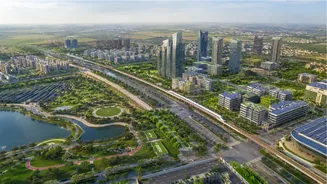







Four 'Namo' new greenfield cities will be developed in the National Capital Region -- one each in Haryana, Delhi, Rajasthan and Uttar Pradesh -- at a cost
of Rs 5,000 crore over the next five years to promote balanced growth across the region, officials said. In its meeting on Tuesday, the NCR Planning Board (NCRPB) decided that no changes would be made to the existing regional boundaries of the NCR and agreed on forming a sub-committee to finalise the Regional Plan 2041. The officials said the NCR will be divided into three zones, with pollution-related and other restrictions applying only to Delhi and the adjoining Central NCR areas, while districts that fall within the region but are located relatively far from the capital will be exempted. The NCRPB did not agree with Haryana's proposal to exclude five peripheral districts -- Karnal, Jind, Panipat, Mahendragarh and Bhiwani -- from the NCR, which comprises 32 districts. Instead, the Central NCR (CNCR) will be developed outside Delhi, extending up to five kilometres beyond the outer edge of the expressway ring formed by the Eastern and Western Peripheral Expressways. According to the proposed 'Regional Plan 2041', the CNCR will serve as the NCR's 'Golden Ring of Opportunity'. An official said there is a plan that if pollution-related restrictions are imposed, authorities concerned will be requested to implement the same in Central NCR only so that far-flung areas of the NCR do not face development challenges. The much-awaited 'Regional Plan 2041' could not be approved at the meeting of the NCR Planning Board, chaired by Union Housing and Urban Affairs Minister Manohar Lal, as participating states could not reach any consensus. Delhi Chief Minister Rekha Gupta, Haryana Chief Minister Nayab Singh Saini and urban development ministers of Rajasthan and Uttar Pradesh attended the meeting. To finalise the Regional Plan 2041, a sub-committee comprising senior officials from the central government and the state governments concerned (Haryana, Uttar Pradesh, Rajasthan, and Delhi) has been constituted. The sub-committee will submit its final report to the Board by August 15. "In today's meeting, we discussed every aspect of the Regional Plan 2041 in detail. It was decided that another meeting will be held after two months and the plan will finally be declared," Lal told reporters here. The four new greenfield cities, to be developed under the name "Namo" cities, will be planned as modern, environmentally friendly and self-reliant urban centres. Lal said that it was decided that these four "Namo Nodes" will be developed along the Regional Rapid Transit System (RRTS) to accommodate the growing population of the region. The minister said the current population of NCR is 7.5 crore and it is expected to rise to 15 crore in the next 15 years. The region will be highly urbanised in the coming decades, with urban populations of about 57 per cent by 2031 and about 67 per cent by 2041. A city node refers to a designated urban centre that is connected to other cities through transport networks and is provided with infrastructure to support housing, employment, education, healthcare and commercial activities. A sum of Rs 5,000 crore will be released for these cities and the development of green areas over the next five years, adding that each of the four states will submit at least three proposals for selection of four "Namo" cities through a challenge, he said. The 'Regional Plan 2041' outlines a long-term strategy for decentralised urban growth through the creation of new economic and residential hubs across Uttar Pradesh, Haryana and Rajasthan. Asked if Delhi would also have a "Namo" city, the minister said the national capital has a large tract of vacant land on its outskirts where a sub-city could be developed. Saini said that various aspects related to the future development of the NCR, urban planning, environmental protection, infrastructure development, and sustainable growth were discussed extensively. The chief minister said that the next meeting of the NCR Planning Board will be held in Gurugram (Haryana) in December this year. "An important decision was also taken to develop four new greenfield cities along with the RRTS (Regional Rapid Transit System). Each member state of the Board will submit a development plan for one new greenfield city," he said. The Union minister said that the Natural Conservation Zone in Aravali will not be touched, adding that NCRPB decided to increase green cover in the NCR region. He said that Delhi and Haryana have yet to submit a survey of their natural conservation zone. Talking to reporters, Uttar Pradesh Development Minister Arvind Kumar Sharma said that during the meeting, he proposed that Jewar, Noida, Bulandshahr or Dadri area be developed as "Namo" city. He said that states have been given a three-month time period to prepare their proposals and in the next meeting of NCRPB, the 'Regional Plan 2041' will be finalised. Under the RP 2041, all heavy vehicles below BS-IV norms will be encouraged to switch to clean fuels under the Parivartan scheme, and the NCR Planning Board will oversee its implementation. The scheme refers to an initiative aimed at phasing out older, polluting, and End-of-Life Vehicles. The officials said that the NCRPB has also identified nine Counter Magnet Areas (CMAs) spread over six adjacent states -- Hisar, Ambala, Kota, Jaipur, Patiala-Rajpura, Kanpur-Lucknow, Bareilly, Gwalior and Dehradun. The region has emerged as the highest contributor to India's GDP in the past few years at 8 per cent, the officials said.