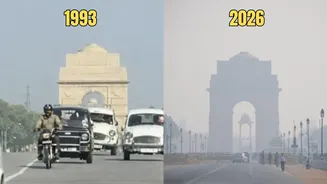

New Delhi: A short clip showing old winter footage of Delhi from 1993 has gone viral on X (formerly Twitter), with many users calling it a reminder of a time
when the capital looked calm, clean and almost pollution-free. The video, shared widely over the weekend, captures a peaceful Delhi — clear skies, soft winter sunlight and a sense of stillness that feels hard to imagine in today’s smog-heavy winters. As the footage continues to trend online, it has triggered not just nostalgia, but also a larger conversation about how much Delhi has changed — in population, vehicles, construction, and the pressures of urban growth.
How Many People Lived in Delhi in 1993?
Under the viral post, a user reportedly asked Grok (X’s AI chatbot) about Delhi’s population back in 1993.Delhi’s population crossed 10 million in 1993, as per projections cited in Delhi’s Economic Survey (1999–2000).
That number is now vastly different, with estimates suggesting Delhi’s metro area population is around 35 million today.
In other words: from 10 million then to about 35 million now — a jump that explains why many viewers say the city’s air, roads and lifestyle no longer feel the same.
Video:
Old footage of Delhi from the 1993 winter shows it was so clean, with no air pollution. It was so peaceful. pic.twitter.com/VkCmDmD21K
— 🚨Indian Gems (@IndianGems_) January 17, 2026
From Quiet Roads to Traffic-packed Streets: What Changed?
The comments under the viral video were filled with a familiar emotion: “Watching old visuals of Delhi from the 90s is bittersweet cleaner air, calmer streets, and a very different pace of life. Progress came fast, but the environmental cost is impossible to ignore.”But beyond emotions, there’s also a clear pattern. As Delhi’s population expanded, so did:
- number of private vehicles
- traffic congestion and fuel emissions
- construction activity and dust
- industries and energy demand
- urban sprawl into NCR
- pressure on infrastructure and public transport
Even as Delhi has improved in many ways — bigger roads, more flyovers, wider connectivity, more infrastructure — the cost of growth has been visible in the air.
Metro Expansion Helped But The City Kept Growing
Many users also pointed out how Delhi’s skyline has transformed — from wide-open spaces to dense development.Delhi Metro has played a major role in reducing dependence on cars for many commuters, but experts often highlight that population and urban expansion have grown at such a fast pace that the challenge has outscaled single solutions.
This Is Not A Blame Game — just a look back
Importantly, the viral video isn’t being discussed as a political debate.Most users are not arguing over who caused pollution. The reasons are well-known and have been discussed for years — vehicle emissions, construction dust, seasonal meteorology, and multiple factors that build up each winter.
This moment online feels more like a collective time-machine — a reminder that there was once a Delhi where winter felt like winter, not a public health emergency.