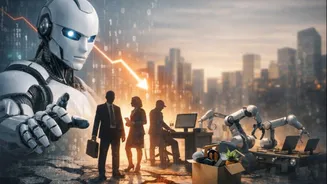







Dubai business tycoon Hussain Sajwani voiced a strong warning about the future of global employment: Artificial Intelligence (AI) is not just a productivity
tool; it is a job-market revolution, and economies dependent on outsourced work could be especially vulnerable. Sajwani’s comments at the World Economic Forum (WEF) 2026 at Davos have sparked a debate over how AI might reshape international labour markets, particularly in India’s massive outsourcing sector. Sajwani, Founder and Chairman of developer DAMAC Group, said that AI is poised to change the world “10 or even 100 times more” than the internet did, and the countries that do not embrace it are at risk of being “left-behind”. He forecasted that nations heavily reliant on outsourced labour would face significant disruption as automation replaces roles that are historically filled by humans. Why is India Vulnerable India, the world’s outsourcing hub, has millions of jobs in IT services, Business Process Outsourcing (BPO), call centres and back-office functions feeding its economic engine. A 2025 industry analysis states that AI-driven automation could revolutionise this very sector. Tata Consultancy Services’ decision to cut 12,200 employees has been interpreted as the beginning of a broader downsizing, potentially affecting up to half a million jobs over the next few years if traditional tasks continue to be automated. Sajwani, at Davos, asserted that, “AI is going to take 80 per cent of accountant jobs, nurses and so on and so forth,” suggesting that AI can perform them faster and cheaper. With BJP-aligned commentators backing his stand on social platforms, many workers worry about what it means for livelihoods built around outsourcing. Sajwani put into perspective the widening global AI adoption gap by comparing it to historical technological setbacks like the Ottoman Empire’s rejection of the typewriter, in his interview with Sky News Arabia. According to a recent LinkedIn poll, the UAE ranks second in the world for AI tool usage among professionals, with a high percentage of workers incorporating generative AI into their daily jobs. There’s still hope for Indians The Indian Economic Survey 2026 stresses that while routine automation may displace some roles, there’s “good news” in the creation of new opportunities and the ongoing demand for human soft skills, creativity and adaptability. These are the attributes that AI is less likely to replicate soon. Similarly, global tech commentators note that in many markets, including the UAE, AI is not just replacing jobs but creating new ones in areas like AI development, data science, robotics and AI integration, while reshaping existing ones. What workers and students should not ignore The message for millions of workers, particularly in sectors tied to outsourcing, is that AI cannot be ignored. They need to reskill, embrace technology and shift towards roles that leverage uniquely human capabilities: creativity, management, ethics and interpersonal communication, and areas where AI assists but does not replace.