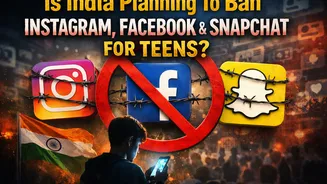





India is weighing possible age restrictions on social media use, with the debate intensifying over whether children under 16 should be allowed to maintain
accounts on major platforms such as Facebook, Instagram and Snapchat. The discussion could pose a fresh challenge for global technology firms operating in one of their largest and fastest-growing markets. Parliamentarian Lavu Sri Krishna Devarayalu, whose party aligns with Prime Minister Narendra Modi’s coalition, said he plans to introduce a private member’s bill in the coming months to bar children below 16 from holding social media accounts. The proposed legislation aims to safeguard data privacy and protect minors from online exploitation, he said in an interview. While private member’s bills rarely become law, they often trigger broader parliamentary debate. The issue has already drawn attention from state governments and the Union finance ministry, reflecting growing concern over the impact of social media on children and adolescents. Any move to limit access in India would significantly affect companies such as Meta Platforms, which operates Facebook and Instagram, Snap Inc.’s Snapchat, and Elon Musk-owned X. Australia’s recent decision to block under-16s from social media has prompted similar discussions worldwide, and a comparable step by India would be the most consequential yet given the sheer scale of its user base. India is the largest market globally for Instagram and Facebook, each with more than 400 million users, according to DataReportal. Snapchat has over 200 million users in the country, making it its biggest market, while X has more than 20 million users. Although revenue per user in India is lower than in developed markets like the US, the country represents vast long-term growth potential due to its large population of first-time internet users. Devarayalu said responsibility for enforcing age restrictions would lie with technology companies. Under his proposed Social Media Age Restrictions and Online Safety Bill, penalties could reach up to ₹2.5 billion, or 5% of a company’s global revenue, whichever is lower. “If India can ban apps like TikTok or online gambling platforms, implementing age restrictions on social media should also be feasible,” he said, pointing to the government’s existing regulatory capabilities. India banned TikTok and several other Chinese apps in 2020 on national security grounds and introduced a law last year prohibiting online gambling. At the state level, Andhra Pradesh has begun examining Australia’s under-16 social media ban, while Maharashtra has set up a task force to study the harms of social media on children. Maharashtra’s IT minister Ashish Shelar recently cited rising digital addiction among minors and its negative effects on mental and physical health, though he said no specific minimum age has yet been proposed. The issue has also found mention in India’s latest Economic Survey, which flagged age-based social media restrictions as a topic for national discussion. Globally, Australia became the first democracy to formally move toward banning social media use for children under 16 in December. Spain has since announced similar plans, while countries including France, the UK and the Netherlands are also considering restrictions, underscoring a widening international push to regulate children’s access to social media platforms.