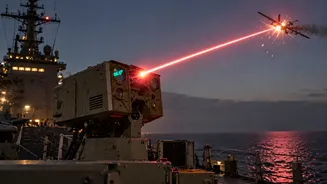








The US military is pushing high-energy laser weapons out of the testing phase and towards the battlefield, with directed-energy systems being used against
drones in the Middle East and tested along the US southern border. The technology, developed over decades, is designed to use concentrated beams of energy to disable or destroy airborne targets. Unlike conventional air-defence missiles, a laser does not require a physical interceptor for every engagement, potentially offering a lower-cost option against certain threats. The latest step came with the US Army awarding AeroVironment an agreement to produce its Enduring-High Energy Laser (E-HEL) system. The supplied report describes the deal as the Army’s first production contract for a high-energy laser weapon and puts its value at around $500 million.
From laboratory testing to battlefield use
The basic principle behind the systems is straightforward: electrical energy is converted into a powerful beam of photons and concentrated on a target. The weapon must maintain the beam on a vulnerable point for several seconds, a process known as “dwell time”.
Mark Neice of Directed Energy Consultants told The New York Post that the systems can track drones and precisely place the beam on their sensors or other parts of the aircraft, potentially disabling the platform or destroying it.
The US Navy has also developed systems such as the High-Energy Laser with Integrated Optical Dazzler and Surveillance (HELIOS), which combines a high-energy laser with optical systems designed to detect, track and disrupt threats.
The technology is already being tested outside controlled laboratory environments. According to the supplied report, US forces have used laser systems around the Strait of Hormuz against drones and incoming threats, while Joint Task Force Southern Border has tested laser technology against drones operated by Mexican drug cartels.
At least 11 drones were reportedly brought down during those border tests.
Lasers offer a different kind of air defence
The attraction is partly economic. Once a laser system is deployed and supplied with sufficient electrical power, each engagement does not require a conventional missile costing potentially hundreds of thousands or millions of dollars.
Brent Ziarnick, a senior fellow in defence studies at the American Foreign Policy Council, said solid-state lasers have relatively few moving parts and could eventually reduce the logistical burden associated with maintaining large ammunition stocks.
The systems nevertheless have important limitations. Lasers require sufficient power and must maintain their beam on a target long enough to deliver the required effect. Atmospheric conditions such as clouds, dust and other obscurants can degrade performance, while large drone swarms could present a different challenge by forcing a defensive system to engage more targets than it can track and defeat simultaneously.
For now, the weapons are also far from the science-fiction image of soldiers carrying portable laser rifles. The most powerful systems are large platforms that require substantial generators, sensors and mounting infrastructure, including installation aboard naval vessels.
The next frontier
The technology is also attracting attention beyond conventional air defence. The US Space Force has been expanding its capabilities in orbit, prompting speculation about whether directed-energy weapons could eventually form part of space-based military systems.
For the moment, however, the focus remains on shorter-range battlefield applications, particularly drones and other relatively low-cost aerial threats.
The Army’s move towards E-HEL production marks a significant change from decades of demonstrations and experimental programmes. The central question is no longer simply whether a laser can destroy a target, but how reliably such systems can operate under battlefield conditions and whether their lower engagement costs can offset limitations in weather, range, power and target capacity.
That shift — from proving the technology works to determining where it can actually replace or supplement conventional weapons — could define the next stage of the US military’s directed-energy programme.