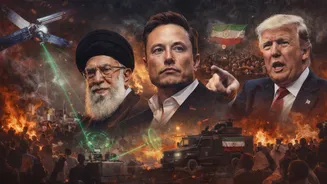

In early January 2026, Iran faced unprecedented protests stemming from economic difficulties made even worse by the imposition of economic sanctions internationally.
As the protest movement gained momentum, the Iranian government attempted to curb the protest mobilization through an Internet blackout. The protest organizers, however, resorted to Elon Musk's Starlink Internet connection system, leading the Iranian regime to engage in sophisticated electronic warfare. The countermeasures, apparently made more effective by the addition of technology from Russia, caused a partial interference in Starlink’s activities, which in turn enabled the government to regain power. While there are claims that the interference was quite successful in stopping it, other reports suggest it was not perfectly effective in achieving the purpose. Economic Crisis and the Spark of Protests The strain faced by the Iranian economy began in 2018 when the US pulled out of JCPOA, but from 2025, there has been an increase in economic challenges faced by the country. After strikes began against Iran from Israeli sites in June 2025, during what has come to be referred to as the Twelve Day War, snapback sanctions were put in place by the UN in September. The US, under President Trump, again launched its "maximum pressure" policy in February 2025, hitting Iran on its economy again. The Rial was again devalued; its rate of inflation was now over 40%, causing food price rises. By early January 2026, protests had begun in all 31 provinces of the nation. Initially, they had been prompted by economic conditions, including fluctuations in the value of the Iranian rial in foreign exchange markets and business shutdowns in Tehran’s Grand Bazaar. This led to violent confrontations between protesters and security forces. Human rights groups claimed the fatalities from the protests had risen to more than 3,000 by mid-January. It should also be noted that the government claimed the protests had been suppressed by January 21 after heavy clampdown measures. The Role of Starlink in Bypassing the Blackout Enacted on January 8, 2026, Iran implemented a near-complete internet blackout, which dropped internet usage to under 2% of its former level. This action aimed to disconnect protest groups while limiting the flow of information. As an intervening measure, the protesters used Starlink terminals that were secretly imported into the country over several years in an estimated range of tens of thousands. This was intensified after the United States issued a series of approvals in 2022 and when Musk enabled Starlink services in Iran in 2025. Subsequently, Starlink also waived subscription costs for users in Iran by January 13. This aided protesters in sharing their content despite the network blockage. Although the interference with this network enhanced jamming attempts, the network continues to work in spots. Tehran’s Electronic Counter-Offensive Iran, meanwhile, adopted a multifaceted approach to disable the Starlink network. Mobile jamming devices were employed to target Ku- and Ka-band satellite signals, resulting in localised blackouts. Similarly, there were attempts to deny the GPS signals, thereby disabling the satellite locking, coupled with a packet loss rate of over 80%. Most important, sophisticated electronic warfare capability acquired from Russia in 2024-2025, including the "Krasukha-4" capable of interfering with satellite communications over several hundred kilometers, is thought to have been used in the conflict. Reportedly, Iranian forces have used the "Murmansk-BN" system, considered to have an extended range, and acquired Chinese technical expertise as well. Security forces carried out raids to confiscate the terminals as well as apprehend users. While there are claims asserting that the Iranian government has not sufficiently jammed the services of Starlink, it has been reported that there has been significant degradation of the connection, transforming it into an intermittent connection by mid-January in many areas. Allegations of Foreign Interference and “Colour Revolution” Claims Iranian authorities have accused the US and Israel of sponsoring a coup attempt through the smuggling of Starlink terminal equipment and arms into the country. Israeli security agency-related statements praising the protests from former US officials were presented as evidence of the two countries’ involvement. Similarly, there were calls from the Kurds regarding strikes, and there were also armed incursions. The rhetoric from the US also ratcheted up, including a message from Trump that ‘help is on the way’ in late December 2025, as well as expressions of solidarity from other US officials with the protesters. A US Carrier Strike Force approached the area in mid-January and this sparked fears of military strikes soon to follow. However, there were no strikes as Trump claimed that he stood down owing to signs of de-escalation. The Iranian authorities had claimed that their efforts in disrupting the coordination had been successful, resulting in the arrest of alleged espionage networks that had been smuggling equipment. The unrest had been portrayed as an unsuccessful ‘colour revolution’ comparable to Ukraine and Belarus. Outcome and Broader Implications By the end of January, protest activity had been minimized, with the government reasserting control through force and technological means. It marked a situation that exposed weaknesses in satellite internet systems and the effectiveness of states in combating them through modern electronic warfare means. The Global South will also note its implications of expanded capabilities—sometimes with Russian help—to counter Western technological hegemony in global affairs. Moreover, inconsistency in claims of successful Starlink signal interference underscores challenges in confirmation amid censorship. Moreover, the crisis sparks broader questions concerning the role of the military in the civilian digital sphere. Such questions have significant implications for sovereignty as regards licensing satellite internet services in countries such as India. As things stand as of January 24, 2026, the situation remains tense though the immediate crisis is now defused.