







What is the story about?
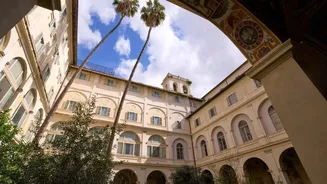
ROME (AP) — A concealed cloister located just steps from Rome’s Pantheon serves as a tranquil retreat for meditation, often overlooked by the throngs of tourists
passing by. Its serene environment contrasts sharply with the bustling city surrounding it. Behind a large wooden door lies a space rich with history, featuring frescoed walls that narrate the cloister's tumultuous past, including significant events such as papal conclaves and the interrogation of Galileo Galilei during the Inquisition.
Cloister's Features and Current Residents
The cloister boasts a central pond inhabited by goldfish and turtles, framed by olive trees and towering palms. A tree heavy with oranges provides ingredients for marmalade, while well-fed cats bask in the sunlight on the grass. Currently, 20 friars reside in the convent adjacent to the cloister, fulfilling their religious obligations.Historical Significance
This cloister has drawn notable figures throughout history, including St. Catherine of Siena and the Renaissance artist Fra Angelico, both of whom are interred in the nearby basilica. The site has hosted pivotal moments, including two papal conclaves and the Roman Inquisition.The basilica next to the cloister, Santa Maria Sopra Minerva, symbolizes its storied past as it stands over the remnants of a pagan temple dedicated to Minerva, the Roman goddess of wisdom.
Art and Architecture
Claudio Strinati, an art historian, describes the cloister as one of the largest and most beautiful in Rome, highlighting its role as a cultural center since ancient times. The original cloister was replaced by a design from architect Guidetto Giudetti, a Michelangelo student, around 1570.The frescoes adorning the walls and vaulted ceilings illustrate the mysteries of the rosary, intended to inspire the Dominican friars' contemplative lifestyle. Other frescoes depict the cloister's complex history and the lives of its inhabitants.
Inquisition and Galileo
During the 16th century, the convent functioned as the headquarters for the Roman Inquisition. Several portraits of decapitated Dominican friars who served as inquisitors can be seen on the walls, depicting their grim fates.Strinati notes that the tribunal of the Inquisition famously interrogated Galileo Galilei here, compelling him to renounce his heliocentric views in 1633 before a panel of judges.
Legacy of Renowned Figures
Fra Angelico, a Dominican painter, resided in the convent while creating frescoes for the Niccoline chapel in the Vatican. A medallion within the cloister depicts him as an elderly man absorbed in his art.Another medallion honors St. Catherine of Siena, whose remains rest in the adjacent basilica. Friar Aucone humorously remarks that while they retain her body, her skull was given to the Dominican Friars in Siena.
Papal Conclaves and Continuing Charm
The cloister was the venue for two significant papal conclaves that elected Pope Eugene IV in 1431 and Pope Nicholas V in 1447. Notably, five popes are interred within the Basilica.Strinati emphasizes that hidden treasures like the cloister adjacent to Santa Maria Sopra Minerva contribute to Rome's allure, stating, “There is all the history hidden and therefore sometimes something is found and all generations, including mine, have discovered things.”