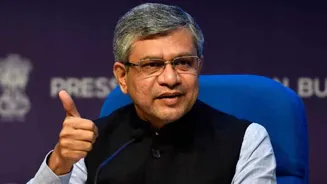







As the government formally rolled out all six pillars of the Semicon 2.0 programme, Electronics and IT Minister Ashwini Vaishnaw made it clear that India’s
semiconductor ambitions extend far beyond setting up a handful of chip plants. His message was straightforward: India wants to become an indispensable part of the global semiconductor supply chain. “People should feel dependent on India. People should become dependent on our country, on our industry, on our production, on our design,” Vaishnaw said while outlining the government's next phase of semiconductor policy. The comment summed up the broader thinking behind Semicon 2.0. While the first phase focused on attracting investments and getting projects off the ground, the next phase is aimed at building a deeper ecosystem around the industry—one that includes chip design, equipment manufacturing, specialty chemicals, gases, materials and skilled talent. Vaishnaw said the biggest change since the launch of Semicon 1.0 in 2022 is the way global industry views India. “When we started, there were genuine doubts about whether semiconductor manufacturing could really take off in India,” he said. “Today, those doubts have been replaced by confidence.” He pointed to the pace at which approved projects moved from clearances to commercial production, arguing that execution has become one of India’s strongest selling points. Throughout the interaction, the minister repeatedly stressed that semiconductor companies are not making investment decisions based solely on incentives. Given the scale and complexity of the industry, firms are looking at whether a country can support growth over the next two or three decades. “Companies look at the long-term prospect of growth in India. Incentives are only one part of the equation,” he said. That long-term approach, according to Vaishnaw, is what shaped the design of Semicon 2.0. The government's focus is now shifting towards building the supporting ecosystem that surrounds semiconductor manufacturing. Global equipment makers, chemical suppliers and gas manufacturers are already showing strong interest in establishing operations in India, he said. If that ecosystem takes root, it could create opportunities far beyond large semiconductor projects. Domestic manufacturers, including MSMEs, could become suppliers of components and precision parts used in semiconductor equipment, embedding Indian companies deeper into global supply chains. The minister also highlighted chip design as a critical area of growth. Under the revamped Design Linked Incentive (DLI) framework, larger Indian companies and startups will be encouraged to develop their own semiconductor products and build globally competitive fabless businesses.
Talent development remains another major focus
According to Vaishnaw, India has already achieved its original target of training 85,000 semiconductor professionals ahead of schedule. The government has now raised that goal to 1.4 lakh engineers as demand for semiconductor talent continues to grow worldwide.
He noted that the global industry is expected to face a shortage of around one million skilled professionals by 2032, creating a significant opportunity for India.
While he avoided putting a number on the investments expected under Semicon 2.0, Vaishnaw made it clear that the government is not chasing headline figures.
“Quality is more important than quantity,” he said, adding that proposals would continue to be evaluated rigorously before receiving approval.
For now, the government's focus is on building foundations rather than counting projects. The objective, Vaishnaw suggested, is not simply to manufacture chips in India, but to ensure that the country becomes a critical link in the global semiconductor value chain for decades to come.