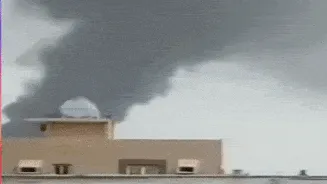









A major fire has broken out at Saudi Aramco's Abqaiq oil processing facility after what Saudi authorities said was a drone attack targeting the site and
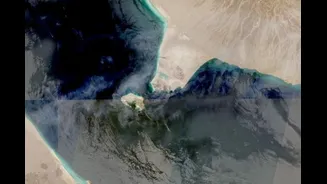
the East-West Pumping Station on Monday. NASA's Fire Information for Resource Management System (FIRMS) detected significant fire activity at the Abqaiq facility, while a satellite image released by the European Union's Copernicus Sentinel-2 programme on 27 July showed smoke rising from the site. Abqaiq is the world's largest crude oil stabilisation plant and processes an estimated 5% to 7% of global oil supply, making it one of the most important facilities in the international energy market. Saudi Arabia blamed Iran-backed armed groups in Iraq for launching the drone attack, saying the drones targeted petroleum facilities, including the Abqaiq refinery and the East-West Pumping Station. The kingdom said it had intercepted other drones targeting petroleum sites, including locations near the capital, Riyadh, and added that it reserved the right to respond.
🛰 Sentinel-2 satellite imagery captured today confirms extensive fires and possible damage, with clearly visible burn scars at Saudi Aramco's Abqaiq oil processing facility, the company's largest oil processing plant, in eastern Saudi Arabia.
The facility was hit in a drone… pic.twitter.com/XBSUOnkRHw— Egypt's Intel Observer (@EGYOSINT) July 27, 2026
Following the attack, authorities began emergency flaring at several production sites as part of their response. The incident has renewed concerns about the vulnerability of key oil infrastructure in the Gulf, with previous disruptions at Abqaiq having triggered sharp increases in global oil prices.
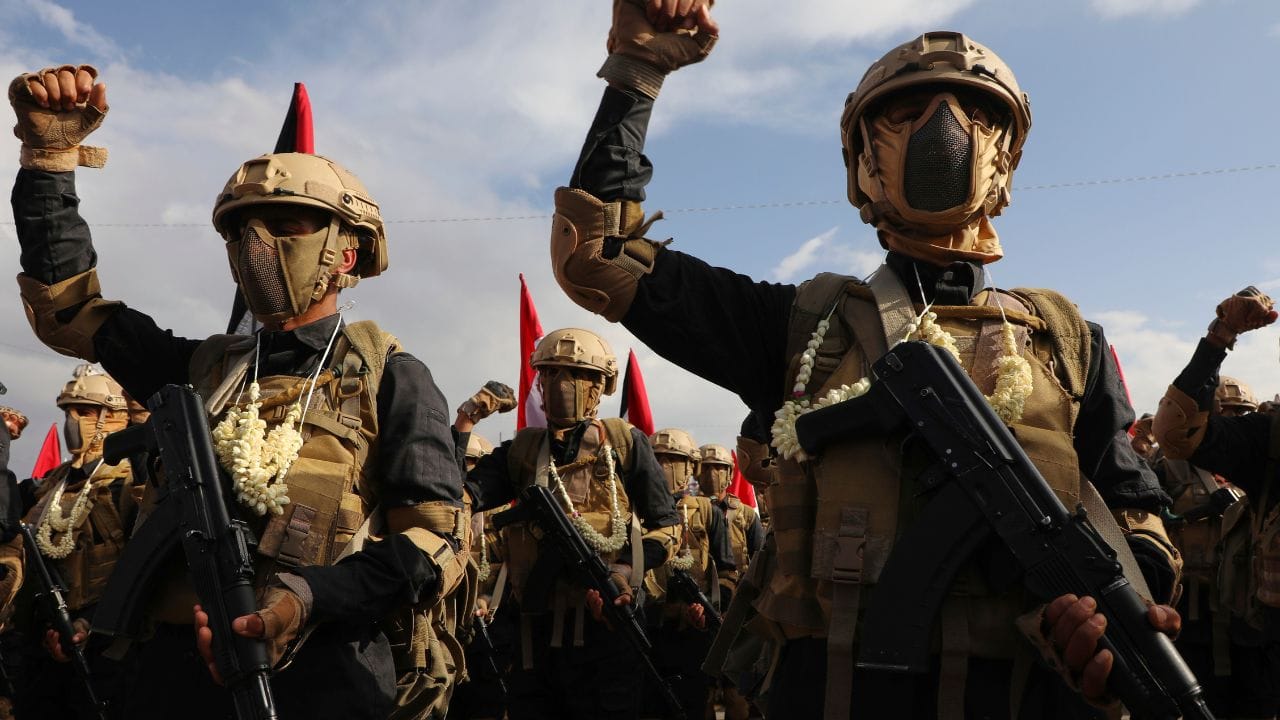
Separately, Yemen's Iran-aligned Houthi movement claimed responsibility for a new wave of attacks targeting Saudi oil infrastructure.
Houthi military spokesman Yahya Saree said the group had struck crude oil supply and transport facilities linking eastern Saudi Arabia to the Red Sea export terminal at Yanbu.
He said the operation was carried out in response to what the Houthis described as Saudi drone incursions into Yemeni airspace.
BREAKING: A massive column of smoke is rising from Saudi Aramco's Abqaiq oil processing facility, the world's largest and the eastern hub of Saudi Arabia's East-West Pipeline, with multiple impacts in the past few hours.
With both ends of the East-West Pipeline now damaged and… pic.twitter.com/2R8hwSe5Co— The Hormuz Letter (@HormuzLetter) July 27, 2026
The group did not provide evidence of the damage caused, and Saudi Aramco did not immediately comment on the claim.
The Houthis have increasingly focused on Saudi Arabia's oil export network after Riyadh expanded the use of the East-West pipeline to transport crude to Yanbu, bypassing disruptions in the Strait of Hormuz.
Last week, the group threatened to blockade Saudi oil exports through the Red Sea, widening concerns over another critical global energy corridor after months of disruption around the Strait of Hormuz.
Saudi Arabia has responded with air strikes on Houthi positions in Yemen, saying it will continue to protect shipping lanes and critical infrastructure.
Elsewhere, Jordan said it had shot down two drones, while Iraqi security officials reported several drone attacks in northern Iraq. Authorities did not identify who launched those drones.
The latest developments came as the United States and Iran maintained a pause in direct military action following nearly two weeks of heightened tensions.
US President Donald Trump said Washington was engaged in "very deep talks with Iran" but warned he remained prepared for "strong military action" if diplomatic efforts failed. The easing of direct hostilities helped push Brent crude prices down by about 6.5% on Monday to just above $90 a barrel after prices briefly rose above $100 during the height of the conflict.
Iran has said it has not requested renewed negotiations with Washington, although officials acknowledged that messages continue to be exchanged through mediators.
Iran also insists it continues to control navigation through the Strait of Hormuz, one of the world's busiest oil transit routes.
Iranian state media reported that six vessels attempting to transit the strait without Tehran's permission were turned back on Monday, with one vessel reportedly involved in an unspecified "incident".
The dispute over navigation through the Strait of Hormuz remains one of the principal points of tension between Washington and Tehran and continues to pose risks to global energy supplies despite ongoing diplomatic contacts.