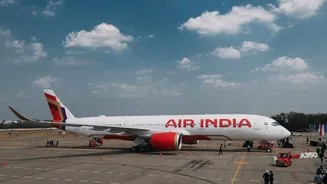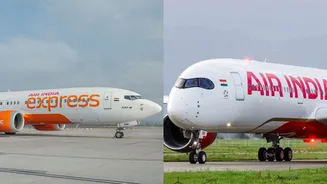









Air India and Air India Express are expected to merge several departments as part of the group’s broader cost-control and operational efficiency drive
under the One Air India integration plan, according to people familiar with the matter. The proposed restructuring aims to eliminate duplication, consolidate corporate operations and improve synergies between the two airlines as the Tata Group-owned aviation business grapples with mounting losses and rising operating costs. Under the Tata group, Air India is a full service carrier and Air India Express is a low cost carrier which will now come under one management. While no the brands will continue, certain departments will be managed at a group level as per new integration plan. A source familiar with the matter told Times Now that the group is looking to consolidate functions such as human resources, finance and other support departments under a common structure, with joint teams comprising personnel from both airlines. “Two teams are doing the same job. Airline don’t need two vendors or contracts can be merged.” Commercial functions, including sales and distribution, marketing, revenue management, network planning and e-commerce, are already operating under a common umbrella. Human resources, finance and other departments remain under discussion, with the process potentially taking another one to two months to finalise. The proposed integrated structure is expected to be presented at an Air India board meeting scheduled for October 15. Air India Express was launched in 2005 as India’s first international budget airline under Air India and was initially designed to operate separately from its full-service parent. While Air India was facing a severe financial crisis, Air India Express remained profitable for five years before privatisation. Following privatisation, however, both airlines have faced financial challenges, with Air India Express’s losses estimated at around Rs 6,700 crore and Air India’s at approximately Rs 22,000 crore.
CEO pushes cost consciousness across the group
The restructuring comes alongside a wider cost-cutting drive outlined by Air India CEO Tewolde Gebremariam in an internal memo accessed by Times Now. Highlighting the need for greater collaboration across the group, he said:
‘As we continue our transformation journey, it is more important than ever that we come together as one team with a shared purpose and unity of direction. When we support one another across the Group, collaborate across functions, and combine our strengths, we unlock the full potential of our Group and accelerate our progress together’.
Gebremariam also emphasised breaking organisational silos and strengthening cooperation across teams under the One Air India initiative.
‘This spirit of unity and collaboration becomes even more important as we navigate an exceptionally challenging operating environment. Ongoing airspace closures, the conflict in the Middle East and its resulting operational disruptions, and persistently high jet fuel costs continue to place significant pressure on airlines across the industry. While these challenges may test us, they also reinforce the importance of standing together, supporting one another, and working collectively toward our shared goals. Our ability to overcome these headwinds will depend not on individual efforts, but on how effectively we come together as one team’.
Emphasising cost control, he added, “Cost savings cannot be driven by a single team or function alone; it requires the active participation and commitment of every employee.”
Cost Savings Team, PRABHAV award introduced
As part of the initiative, Air India has established a full-time, cross-functional Cost Savings Team to review expenditure and identify savings across departments.
The airline is also launching ‘PRABHAV – The Value Creator Award’ to encourage employees to suggest cost-saving measures, including contract renegotiation, improved resource utilisation, more efficient procurement, process improvements and waste reduction. Ideas that can be implemented will be recognised and rewarded under the programme.
Gebremariam urged employees to question spending and adopt a more disciplined approach to expenditure, saying, “We should continually challenge ourselves to ask – is this expenditure necessary? Is there a more efficient way to achieve the same outcome?”
The airline has also revised its SOD approval matrix as part of tighter spending controls. ‘As another step in reinforcing our focus on cost consciousness and disciplined decision-making, we have revised the SOD approval matrix. Effective October 1, all approvals will now be routed through the HOD, CXO, and CEO, ensuring greater rigour, transparency, and alignment in decision-making across the organisation’, Gebremariam said.
The measures come as Air India seeks to build a leaner and more financially resilient business. Consolidating departments, rationalising vendor contracts and tightening expenditure approvals are expected to support its broader effort to improve efficiency and contain costs amid sustained financial and operational pressure.