




What is the story about?
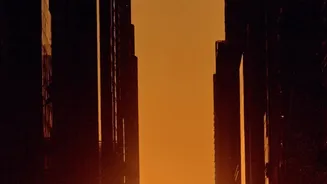
NEW YORK (AP) — Each year, New York City residents and visitors gather to witness Manhattanhenge, a twice-yearly astronomical event where the setting sun
aligns perfectly with the city's street grid. This year, the first occurrence took place on Thursday, as the sun descended behind the iconic skyscrapers, creating a stunning view along the east-west streets. A second opportunity to experience this phenomenon is expected on Friday, with additional alignments on July 11 and 12.
Understanding Manhattanhenge
Manhattanhenge typically occurs approximately three weeks before and after the summer solstice, which falls on June 21. This alignment occurs when the sun sets directly in line with the Manhattan street grid.Photographers and onlookers flock to the streets during this time, capturing the breathtaking views as the sun illuminates the cityscape. The event has become a cherished tradition for many in the city.
Origin of the Term
The term 'Manhattanhenge' was coined by astrophysicist Neil deGrasse Tyson in a 1997 article for 'Natural History.' Tyson drew inspiration from his visit to Stonehenge as a teenager, noting the similarity between the sun's rays striking the ancient monument and the sun's alignment with New York's skyscrapers.Unlike the builders of Stonehenge, the planners of Manhattan did not design the city with solar alignment in mind; however, the resulting phenomenon has captivated many.
Viewing Locations
To best experience Manhattanhenge, viewers should gather at key locations along the city’s major east-west streets, including 14th, 23rd, 34th, 42nd, and 57th Streets. The views become increasingly dramatic as one moves further east, where the sunlight reflects off building facades.Long Island City in Queens also offers a vantage point to observe this phenomenon across the East River.