





What is the story about?
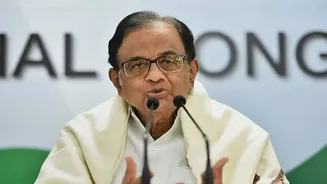
New Delhi: Senior Congress leader P. Chidamabaram on Tuesday flagged V-Dem's Electoral Democracy Index about India. Notably, the institute ranked India at
the 106th position out of 179 in its Electoral Democracy Index. Chidambaram pointed out that V-Dem's democracy index score for India was at the lowest since 1975. “Without comment: India ranks 106th among 179 countries on the Electoral Democracy Index. V-Dem's democracy index score for India is at its lowest since 1975,” the senior Congress leader wrote.
What V-Demi's Report Indicated?
V-Dem assigned India an Electoral Democracy Index score of 0.38 for 2025, placing it 106th globally, while it ranked 105th on the Liberal Democracy Index with a score of 0.26.V-Dem’s Population-Weighted Measures assess the level of democracy experienced statistically by the average person worldwide. However, its country averages assign equal weight to democratic changes in smaller nations such as Seychelles and Timor-Leste and larger countries like India and the US.
Comparison With Other South And Central Asian Countries:
Notably, it put India under the electoral 'autocracy' category alongside Kazakhstan and Pakistan.Meanwhile, the report stated that just 2 per cent of people in South and Central Asia live under electoral democracy, mainly in Nepal and Sri Lanka, while a very small share resides in “grey zone” democracies such as Bhutan, Mongolia and the Maldives.
Previous Reports Of V-Dem:
According to the V-Dem report published in March 2024, there was a broader decline across nearly all democratic indicators, with freedom of expression, fair elections, and freedom of association and civil society emerging as the most severely affected areas in countries undergoing autocratisation. It was placed on the 100th spot,India was downgraded to the status of an “electoral autocracy” in 2018. As per the ‘Democracy Report 2024’ released by V-Dem Institute, the country had declined even further on multiple metrics.
In 2025, India was 105th on the liberal democracy index.
About 1975 Emergency:
In 1975, the then-President, Fakhruddin Ali Ahmed, imposed the Emergency across the country under Article 352, acting on the advice of Gandhi. The period lasted for 21 months, until 21 March 1977.
Major events under emergency:
Media Censorship: all newspaper content was subject to clearance by the Prime Minister’s Office. In protest, media outlets ran blank editorial spaces, while publications critical of the government or Emergency were banned.
Forced Sterilization: Indira Gandhi’s younger son, Sanjay Gandhi, spearheaded an aggressive family planning drive, during which men were forcibly subjected to sterilisation. In 1976 alone, millions of such procedures were conducted nationwide.
Supreme Court Verdict: In a 4–1 verdict, the Supreme Court held that during a national emergency, access to courts for enforcing fundamental rights could be suspended, including the right to seek habeas corpus.
The 42nd Amendment: The Indira Gandhi government introduced the 42nd Constitutional Amendment, making sweeping changes to the law. The changes were so extensive that it was dubbed the ‘Mini-Constitution’.
(Note: The Bharatiya Janata Party (BJP) has not yet responded to the report. The story will be updated with the saffron party's reaction)