






What is the story about?
Israel warned on Friday that it will escalate its military operations against Iran as tensions continue to rise with Tehran's missile attacks on Israel and
Gulf Arab nations. The U.S. military has also intensified its strikes against Iranian targets, while President Donald Trump has postponed his ultimatum regarding Iran's control of the Strait of Hormuz. Israeli forces have deployed thousands of troops into Lebanon, aiming to secure control over the territory south of the Litani River, which is approximately 20 miles (30 kilometers) from the Israeli border. This military maneuver comes amid a broader conflict that has resulted in significant casualties and displacement in the region.
U.S. Military Actions and Economic Impact
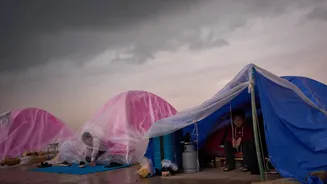
In light of a volatile stock market, President Trump announced on Thursday that he would extend the deadline for reopening the Strait of Hormuz until April 6. He stated that Iran requested this extension and claimed negotiations were progressing well, despite Iran's public denial of any ongoing talks with the U.S. regarding a 15-point proposal to resolve the conflict.The ongoing war has resulted in over 1,900 deaths in Iran and nearly 1,100 in Lebanon. In Israel, 18 individuals have lost their lives, including four soldiers killed in Lebanon. Additionally, 13 U.S. military personnel have died, alongside numerous civilians affected by the conflict in the Gulf region, leading to millions being displaced in both Lebanon and Iran.
Global Food Security Concerns
The World Food Program (WFP) has warned that the conflict in the Middle East could escalate global food insecurity to 363 million people, an increase from previous estimates of 318 million by 2026. The agency attributes this rise to soaring energy prices driven by the ongoing violence, which disproportionately affects low-income nations.WFP officials noted that per capita incomes in poorer countries have not yet returned to pre-pandemic levels, with food prices increasing by 15% in numerous countries and more than 50% in places like Venezuela, Iran, and Sudan.
Protests Against the War in the U.S.
In the United States, opposition to the war has galvanized support for the 'No Kings' protests, with over 9 million Americans expected to participate in demonstrations against the Trump administration on Saturday. Bruce Springsteen is set to headline these events, emphasizing the defense of American democratic values and freedoms.More than 3,100 events are planned across all 50 states, reflecting growing resistance to the administration's policies. Protests are also scheduled in various countries, including Canada, Germany, and the UK, where the slogan 'No Tyrants' will be used.
Casualties and Humanitarian Impact in Lebanon
The death toll in Lebanon has reached 1,142, including a pregnant woman killed by an Israeli airstrike in the village of Bazalieh. The Health Ministry reported that 26 people died and 86 were wounded in the past 24 hours, raising the total number of injured to 3,315 since the latest conflict began on March 2.Cultural Resilience Amidst Conflict
Despite the destruction caused by U.S.-Israeli strikes, bookshops in Tehran are reportedly thriving as safe havens for civilians. Ali Jafarabadi, head of Iran's largest bookshop chain, noted that his stores have seen strong customer turnout, emphasizing a cultural craving among the populace despite the ongoing war.Jafarabadi remarked, 'It shows people are craving books, people are craving culture, people are craving a safe space where they can come and connect with each other. That — that is the people of Iran.'
Military Developments and International Reactions
Israel's military has launched strikes targeting Hezbollah infrastructure in Beirut, with warplanes conducting operations over the Lebanese capital. Meanwhile, U.S. Central Command reported that 303 U.S. troops have been injured in the conflict, with 273 having returned to duty.In response to the humanitarian crisis, Russia has dispatched medical supplies to Iran, delivering 313 metric tons of medicines as part of an ongoing support effort.
Political Divisions and Calls for Peace
The Iran war has sparked a generational divide among conservatives in the U.S., with younger attendees at the Conservative Political Action Conference expressing disappointment over Trump's military actions, while older conservatives defend the strikes as necessary. The division reflects broader concerns about the implications of military engagement.In a letter to the Israeli military's chief of staff, a group of mothers of soldiers has called for an end to the ground offensive in Lebanon, urging a focus on political solutions to the conflict.