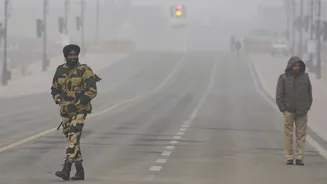

Delhi AQI Today: Delhi shivered through its coldest day of 2026 on Tuesday as maximum temperatures plunged sharply, officially marking the season’s first
‘cold day’ in the national capital, even as worsening air quality and dense fog raised concerns over road traffic and flight operations across the city.
First ‘Cold Day’ of the Year: What IMD Said
According to the India Meteorological Department, maximum temperatures across Delhi ranged between 13°C and 16°C, with cold day conditions recorded at Palam and Lodhi Road. The weather office defines a cold day as one where the maximum temperature remains 4.5°C to 6.4°C below the seasonal normal.Delhi’s maximum temperature on Tuesday settled at 15.7°C, about 3.3 degrees below normal, while the minimum temperature stood at 7.6°C, slightly above the seasonal average. Palam was the coldest pocket, recording a maximum of just 13°C, nearly 5.7 degrees below normal.
Check AQI of Your City and Area
IMD data showed Safdarjung at 15.7°C, Lodhi Road at 15.8°C, Ridge at 14.9°C, and Ayanagar at 14°C. Minimum temperatures hovered around 7.6°C at most stations, with Palam dipping to 6.5°C during the early morning hours. Relative humidity remained unusually high, touching 100 per cent in the morning and 91 per cent by evening, adding to the discomfort.
Delhi Weather: Dense Fog, Yellow Alert Issued
The weather department has issued a yellow alert for Wednesday, warning of dense fog during morning hours. Maximum and minimum temperatures are expected to remain around 16°C and 7°C, with cold day conditions likely to continue, offering little relief to residents.
Delhi AQI Slips to ‘Very Poor’
Alongside the cold spell, Delhi’s air quality deteriorated further. The 24-hour average AQI dropped to 310, placing it firmly in the ‘very poor’ category, compared to 244 recorded a day earlier, as per data from the Central Pollution Control Board.Out of the city’s monitoring stations, 27 reported very poor air quality, 10 were in the poor category, and only one station recorded moderate air quality. Mundka emerged as the worst-hit area, with an AQI of 369 in the evening. During the morning hours, AQI briefly improved to 293 (poor) before worsening again.
The Decision Support System flagged transport emissions as the biggest contributor at 14.9 per cent, followed by peripheral industries (12.2 per cent) and residential sources (3.7 per cent). Among NCR districts, Sonipat (13.2 per cent) and Jhajjar (12.1 per cent) were the highest contributors to Delhi’s pollution load.
The Air Quality Early Warning System has forecast that Delhi’s air quality will remain ‘very poor’ from January 7 to January 9 and is likely to stay in the same range for at least six more days.
Fog Disruptions Loom Over Flight Operations
Amid dense fog conditions, Air India issued a travel advisory for passengers flying on the morning of January 7, cautioning that reduced visibility over Delhi and parts of north India could lead to delays, diversions or cancellations.
The airline said it is closely monitoring the situation and has activated proactive measures, including its FogCare initiative, under which affected passengers are informed in advance and offered free rescheduling or full refunds without penalty.
Flight operations at Indira Gandhi International Airport continued under CAT III conditions, which allow aircraft to land in extremely low visibility using advanced Instrument Landing Systems and trained crews. Airport authorities confirmed that both arrivals and departures are operational, though passengers may experience delays.
With dense fog, biting cold and very poor air quality converging, authorities have urged residents to plan travel carefully, check flight statuses in advance and allow extra time for airport commutes. As Delhi settles into its first intense winter spell of 2026, both weather and pollution are expected to remain challenging in the days ahead.
(with inputs from PTI, ANI)