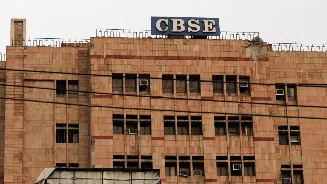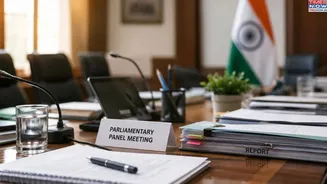





The parliamentary panel has called a meeting on June 2, 2026, with the Union Education Ministry and CBSE officials to scrutinise the utilisation of the On-Screen
Marking (OSM) system and the technical glitches faced by intermediate students in the post-result process, as per a Rajya Sabha Secretariat notice. Besides the CBSE’s marking and reassessment issues, the Parliamentary Standing Committee on Education, Women, Children, Youth and Sports will talk about the execution of the three-language formula in Classes 9 and 10 in 2026. Led by Congress leader Digvijaya Singh, the committee has summoned School Education Secretary Sanjay Kumar and Central Board of Secondary Education (CBSE) Chairman Rahul Singh for a discussion on June 2. The main objective of the meeting is to inspect the "use of On-Screen Marking (OSM) in Grade 12 Exams and issues faced by students consequent to it" and the "application of the 3-language formula in Classes 9 and 10", according to the notice. Ever since the CBSE Class 12 results 2026 were declared, the board has been facing intense backlash over the digital marking scheme debuted this year. Technical glitches, payment failures, and access-related issues, when the board finally lowered the revaluation fees and opened the post-result process window, further aggravated the situation. Check Out | 'Anyone Could Edit Marks': 19-Year-Old Ethical Hacker Alleges Major Security Flaws In CBSE Evaluation System Amid the chaos, CBSE decided to make the three-language formula ‘compulsory’ for students of Classes 9 and 10. While some welcomed the move, others didn’t like the imposition of R3 on them. When Times Now Digital reached out to a Class X student to share her opinion on this, Ananya Singh, a student of St. Francis, Indara Mau, UP, said, “If we don’t have the option to choose any foreign language (besides English) as R3, then I think it’s an academic burden because Hindi is enough as a native language. Also, I believe that students should be given an option to choose, rather than being asked to learn three languages with only one foreign option among them.” When questioned about whether her school is capable of providing proficient teachers for the third language, Ananya remarked, “I do think that our school is capable of hiring teachers skilled in the languages being taught at the school. Although I’ve struggled to comprehend topics taught by Science teachers, it never happened with language teachers.” CBSE’s three-language policy will be rolled out for both Classes 9 and 10 students from July 1, 2026. The board has said that until the R3 textbooks are made available, Class 9 students shall use the Class 6 R3 textbooks (2026-27 edition) of the chosen language. In addition to this, CBSE has suggested that schools use existing faculty with language proficiency if there’s a shortage of language teachers. They can also go for cluster-based teaching models, online or hybrid classes, seek help from retired language teachers, or ask qualified PG students to pitch in during the transition phase. The move is in line with the National Education Policy (NEP) 2020 and the National Curriculum Framework for School Education (NCF-SE) 2023. Although the board has maintained that no board exams shall be conducted for the third language, the new rule has faced condemnation from many students, educators, and even political leaders. Tamil Nadu has explicitly opposed the three-language formula, stating that it puts an unjust burden on non-Hindi-speaking states and weakens regional linguistic identity. The state has followed a two-language policy -- Tamil and English. According to the notice, the committee will hold another meeting on June 1. On June 1, the panel will first meet at 10 am to consider and adopt the "381st Report on Action Taken by the Government on the Recommendations and Observations contained in the 364th Report on Demands for Grants (2025-26) of the Department of Higher Education, Ministry of Education". The official notice states that the committee will convene on June 1, 2026. On this day, the panel shall first meet at 10 am to consider and adopt the "381st Report on Action Taken by the Government on the Recommendations and Observations contained in the 364th Report on Demands for Grants (2025-26) of the Department of Higher Education, Ministry of Education". Subsequently, the panel will meet the secretaries of the Department of Higher Education and the Health Ministry, the Director General of the National Testing Agency (NTA), representatives of the United Doctors Front, and Dr (Major) Gulshan Garg, a former orthopaedic surgeon of the Indian Air Force, at 11 am. The June 1 meeting is aimed at discussing the "use of pen-and-paper testing versus CBT" and "views pertaining to NEET and NTA", the notice said. Previously, the committee convened on May 21 to examine the rollout of reforms in the National Testing Agency (NTA), the NEET-UG 2026 paper leak case, and the implementation of the Radhakrishnan Committee's recommendations.