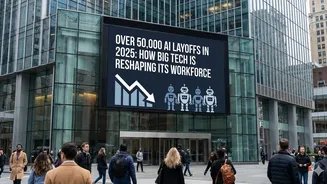

Job losses linked directly to artificial intelligence crossed the 50,000 mark in 2025, underlining how rapidly automation is reshaping employment across
the technology sector. According to data from consulting firm Challenger, Gray & Christmas, companies in the US alone cited AI as the reason for 54,883 layoffs this year, making it one of the most significant drivers of workforce reductions. The acceleration in AI-led restructuring comes as companies look to control costs amid inflationary pressures, higher tariffs and slowing growth, while simultaneously investing heavily in automation to boost productivity. A recent MIT study released in November estimated that AI is already capable of handling 11.7% of US jobs, potentially saving employers $1.2 trillion in wages across sectors such as finance, healthcare and professional services. That said, not everyone agrees AI is the sole culprit. Fabian Stephany, assistant professor of AI and work at the Oxford Internet Institute, told CNBC that many firms may be using AI as a convenient justification after aggressive hiring during the pandemic. Despite this debate, several major technology companies have explicitly cited AI while announcing job cuts in 2025. Below are four of the biggest firms that openly linked AI to workforce changes. Amazon: Leaner Teams For An AI-First Organisation Amazon laid off around 14,000 corporate employees in one of its largest workforce reductions this year. Explaining the decision, Beth Galetti, Senior Vice President of People Experience and Technology, said the company was reorganising to move faster by cutting layers and increasing ownership. She described generative AI as “the most transformative technology since the internet,” adding that it allows companies to innovate at unprecedented speed. According to Galetti, this shift requires a leaner structure to better serve customers and business priorities. However, Amazon CEO Andy Jassy later clarified during an earnings call that the layoffs were not primarily driven by AI or financial stress. Instead, he said the move was more about reshaping company culture and improving execution. Microsoft: AI Adoption Becomes A Performance Metric Microsoft carried out multiple rounds of layoffs in 2025, cutting an estimated 15,000 roles. The restructuring coincided with a stronger internal push to integrate AI into everyday work. Julia Liuson, President of Microsoft’s Developer Division, told managers that AI usage should form part of performance evaluations. In internal communications, she stressed that using AI tools is “no longer optional” and is expected at every level of the organisation. Sources familiar with the matter said Microsoft is also exploring the inclusion of formal AI usage benchmarks in employee reviews, as it continues to expand adoption of its Copilot AI products across teams. Salesforce: AI Automates Half Of Support Work Salesforce confirmed in September that it had eliminated around 4,000 customer support roles, with CEO Marc Benioff directly attributing the cuts to AI-driven automation. Benioff said AI is already handling up to 50% of the company’s workload, reducing the need for large support teams. Speaking on the Logan Bartlett podcast, he described the AI transition as one of the most transformative phases of his career. He explained that Salesforce had millions of customer leads over the years that went unaddressed due to staffing constraints, a gap now filled by AI-powered sales agents. The company also uses an “omnichannel supervisor” system that allows AI to work alongside humans, escalating tasks that require judgment or intervention. IBM: AI Replaces HR Roles, Hiring Shifts To High-Skill Jobs IBM has also leaned into AI-led restructuring. In an interview with The Wall Street Journal, CEO Arvind Krishna revealed that AI chatbots had replaced several hundred HR positions, including about 200 roles in human resources. The company has also reduced jobs in marketing and communications while continuing to hire for positions that require complex decision-making, such as engineering, sales and advanced marketing. Krishna said AI is freeing up resources, allowing IBM to focus hiring on roles that demand deeper critical thinking and creativity. While companies differ on how directly AI is responsible for job losses, one trend is clear: automation is no longer a future risk—it is already reshaping corporate workforces. Whether AI is driving layoffs or simply accelerating long-planned restructuring, 2025 marks a turning point in how technology firms balance efficiency, innovation and employment.