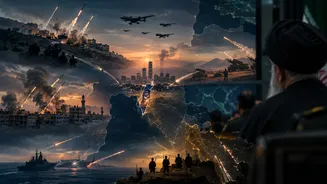







Israeli intelligence assessments reportedly point to Iran preparing for a large scale, coordinated assault on Israel that would open on multiple fronts
at once, a scenario that echoes the kind of surprise attack seen on October 7 but with far tighter coordination built in from the start, according to a report from Jerusalem Post. Under the alleged assessments, Iran is looking to fold together its own military capability with Hezbollah in Lebanon, Hamas, the Houthis in Yemen and Iran aligned militias operating in Iraq, folding them all into a single unified campaign rather than separate, disconnected actions. The October 7 attack itself was carried out by Hamas without the other fronts opening in full coordination at the same time. Yet the ambition for a wider regional confrontation with Israel existed even before that attack took place. Planning documents from Hamas that were seized in Gaza after the attack showed that Yahya Sinwar had wanted to broaden the fight and pull additional battlefronts into the conflict. One of those documents specifically emphasized linking up and preparing what it called the external fronts, referring to Lebanon, Syria and Sinai, and arranging communication systems in advance that could function both in ordinary times and during active war. Despite that planning, published assessments from the US and Israel indicated that Iran and Hezbollah were not given full details about the October 7 operation ahead of time, including its exact timing. Sinwar reportedly expected that a successful initial strike would pull Hezbollah and Iran into a broader campaign on its own. In practice, Hezbollah did open fire in northern Israel that day but stopped short of launching a coordinated, large scale assault alongside Hamas's attack that same morning.
Iran's Apparent Effort to Close That Gap
Reports circulating in Arab media suggest Tehran is now working specifically to fix that coordination problem. The plan reportedly being developed would let multiple fronts act against Israel simultaneously, making that kind of unified timing central to the strategy rather than something left to chance.Leadership Changes Within Hamas
A shift in Hamas leadership adds another layer to this picture. Khalil al-Hayya, elected as the group's overall leader in July, is seen as having strong ties to Iran and has long served as one of Hamas's key figures in maintaining its relationship with Tehran.Al-Hayya belongs to Hamas's Gaza based faction and was close to Sinwar, a background that strengthens the influence of the wing within Hamas leadership that wants to keep the organization closely aligned with Iran strategically.
Signs of a Rebuilt Regional Network
There are also indications that Iran is working to rebuild what has been called the Axis of Resistance and restore coordination channels among its various allied groups. A report from last month said the IDF had detected renewed coordination between Hamas and Hezbollah, aided by Iran, aimed at raising pressure on Israel from both the north and south at the same time.According to a published IDF assessment, Hamas and Hezbollah had already started ramping up coordinated activity in recent weeks with Iranian support.