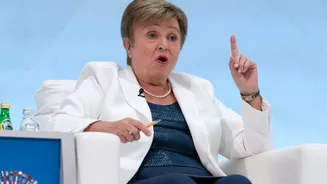








Praising India's growth story, the International Monetary Fund chief Kristalina Georgieva on Thursday said, "India's growth rate is more than two times
higher than the average global growth." "Look at India today. India's growth rate is more than two times higher than the average global growth. That is happening because the country has strong fundamentals," says International Monetary Fund chief Kristalina Georgieva. She said there are no signs of a sharp slowdown in India’s growth path, even as the global economy faces headwinds from geopolitical tensions and supply disruptions linked to the West Asia conflict. Also Read: Is Global Finance Ready for AI Cyber Threats? IMF Chief Raises Red Flag IMF Chief attributed India’s resilience to factors such as macroeconomic stability and robust domestic demand, which continue to support momentum. However, Georgieva cautioned that policymakers should remain attentive to developments in the financial sector. She pointed out that parts of the financial system appear to be holding substantial liquidity and relative strength, suggesting the need for close monitoring to ensure stability as conditions evolve. Recently, the IMF had projected that the Indian economy is expected to grow at 6.5 percent in 2027 despite escalating tensions in West Asia. The 6.5 percent growth projection makes India the fastest-growing major economy in 2026. IMF cuts global growth forecast IMF has recently lowered its global economic growth forecast amid the West Asia tensions that have driven up energy and food costs globally. IMF said it expected the global economy to grow by 3.1 percent this year, a slowdown from its earlier forecast of 3.3 percent, which it had released before the US and Israel began their war on Iran on February 28. IMF cut GDP growth forecasts for Saudi Arabia from 4.5 percent to 3.1 percent. While for Iran, an initial small amount of growth forecast in 2026 was cut by 7.2 points, resulting in a forecast contraction of 6.1 percent. IMF slashed its 2026 forecast for the Middle East and Central Asia by 2 percentage points to 1.9 percent.