








India’s economic growth is likely to face new challenges as the ongoing conflict in West Asia related to the US-Iran-Israeli conflict begins to ripple
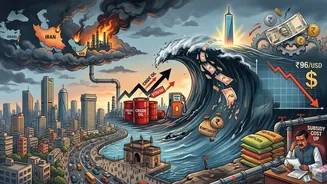
through key financial channels in the country. The impact of the conflict may not be limited to rising oil prices but could extend to remittances, currency stability, and government finances, according to a recent report by SBI Funds Management. The report titled "2026 Middle East Conflict and Its Implications" highlights multiple risks that could put pressure on India’s external and fiscal balances in the coming months. One of the most immediate concerns highlighted in the report is the potential dip in remittance inflows. A major portion of money sent back to India comes from the Gulf region, making it highly sensitive to disruptions there. "Remittance inflows are also likely to be affected, as about 38 per cent of total inward remittances originate from the Middle East--half of which come from the UAE alone," the report said. A slowdown in these inflows could directly impact household incomes and consumption patterns in India, particularly in states heavily dependent on overseas earnings. Rising Crude Oil Price Impact The report also draws attention to the risks arising from sustained high crude oil prices. A rise in oil costs can significantly worsen India’s current account balance, adding pressure to the broader economy. "Every US$10/bbl rise in crude price widens the annual CAD by US$15 billion," it noted. In a scenario where oil prices hover near $100 per barrel for a prolonged period, the current account deficit could expand sharply. "Current account deficit widening by US$70bn," the report estimated under a high-price scenario. Currency stability is another area of concern amid ongoing geopolitical stress. The report points out that the rupee could face further depreciation if foreign investment inflows remain uncertain. "If FII inflows fail to revive, the rupee will remain vulnerable to global shocks. We now expect a 4-5 per cent depreciation in 2026 (vs. an earlier expectation of 2-3 per cent). The rupee, currently trading at Rs 93 per US dollar, could move toward Rs 96 per US dollar over the next two quarters," the report said. Weak Capital Inflows The report highlights a sharp increase in fertiliser costs, which may push up expenditure. "Global fertiliser prices have risen sharply, with urea now almost 50 per cent higher since December 2025," the report said, adding that the subsidy requirement could rise significantly if costs remain elevated. "Rising gas costs and fertiliser inflation could push the subsidy requirement upward by Rs. 300 billion or more," the report noted. Another structural concern flagged is the weakening balance of payments position. Despite improvements in current account dynamics over the years, weak capital inflows remain a challenge. "Despite a structural improvement in India's current-account dynamics and a CAD that has remained below 2 per cent of GDP since FY15 (except FY19 at 2.1 per cent), India's balance-of-payments position has weakened materially due to near-zero net FDI inflows," the report said, adding that this has led to a deterioration in India's basic balance.