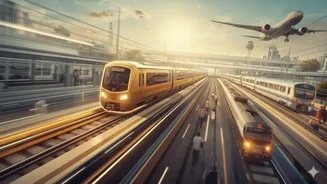







Mumbai Metro 8: The much-awaited Gold Line of Mumbai Metro 8 is not just expected to cut down travel time between Maharashtra's two huge airports - Navi
Mumbai International Airport and Chhatrapati Shivaji International Airport - but also enhancing other modes of public transport. This line is supposed to share the growing traffic in the city, resulting in frequent gridlocks and noise pollution. Its significance is the strategic design that will provide a smooth transition for people among metro, train and cabs (in reference to road traffic). Key locations such as Marol Naka, Saki Naka, Kurla, and Lokmanya Tilak Terminus (LTT) will play a pivotal role in this transformation, turning the Gold Line into one of Mumbai’s most important transit corridors.
HOW
Kurla's integration into Mumbai Metro 8 can be seen as a gateway between suburban rail, metro, and airports. It is the busiest busiest suburban rail nodes of Mumbai, and it can offer faster airport and Navi Mumbai access for central city commuters travelling via Gold Line Metro.With suburban rail, metro connectivity, and proximity to commercial districts, Kurla’s integration into Line 8 is expected to ease pressure on existing transport systems.
Also Read: New Traffic Rules in Mumbai to Cut Congestion from February 1: What’s Allowed, What’s Banned
The Gold Line will intersect with existing Metro Lines 1 and 3 at Marol Naka and Saki Naka, several media reports suggested. With that, the metro stretch will eventually provide metro commuters smooth east–west and north–south connectivity. Also, these interchanges will allow them from western and central Mumbai to seamlessly access airport-bound services, while chucking out road traffic.
The inclusion of Lokmanya Tilak Terminus (LTT) - a major long-distance railway hub - adds another layer of regional importance to the corridor. Those travelling from across Maharashtra and other states can go 'Mumbai Darshan' (Mumbai Sightseeing) via Gold Line. It will allow passengers from long-distance trains to use the metro network easily, drastically simplifying onward travel to both Mumbai and Navi Mumbai airports.
Single Corridor, Multiple Modes
Urban transport experts view this alignment as a shift from isolated metro corridors to a network-first approach. They appreciated the design, saying it focuses on hassle-free transfers rather than isolated routes. Linking multiple transit modes along a single corridor will not only reduce transfer times, but also decongest arterial road.This line is also a need of the hour as Mumbai is preparing for the Navi Mumbai International Airport operations to begin. The Metro Line 8’s interchange heavy design is expected to meet the intercity travel demand rising due to the upcoming airport.
Possible Side-Effects of Mumbai Metro 8
The Gold Line is expected to make airport travel much faster. However, its route through crowded areas like Saki Naka and Kurla could pose significant challenges. The project may also involve cutting down a substantial number of trees. Without careful planning and coordination, these busy stretches risk becoming bottlenecks instead of gateways for efficient transit.
About the Mumbai Metro 8
When It will be Completed: The project is expected to complete in nearly three years from the start of construction. Officials said they are aiming for 2029 for full operation, and began work on the proposed metro line once the approvals are received.
Budget / Cost: The estimated cost of the project is Rs 22,862 crore (~$2.7 billion USD). It will be built through Public-Private Partnership (PPP), with CIDCO requesting 20% viability gap funding from central and state governments.
Track Length: The total corridor will span 35 kilometers, with 20 stations (6 underground, 14 elevated).