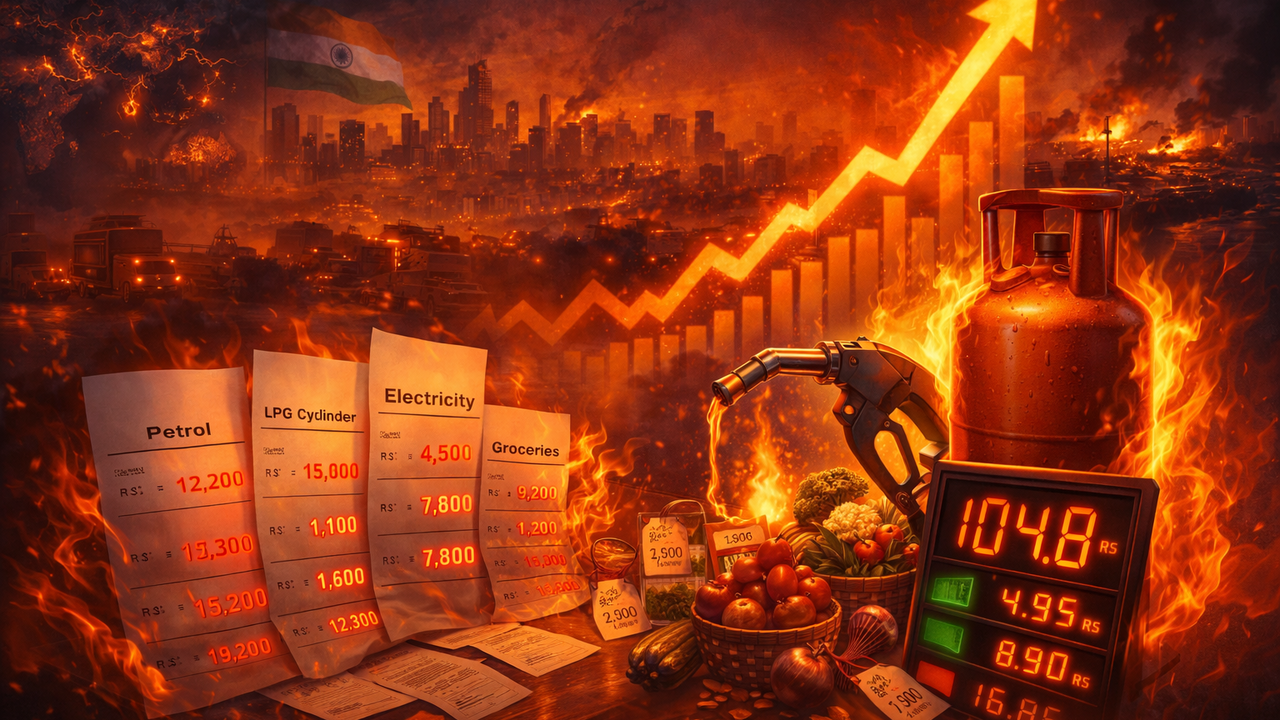



Amid the rising energy prices due to the West Asia crisis, India's growth story is set to feel the heat as the retail inflation is likely to pushed to 4.5%
in the Financial Year 2027. ICICI Bank in its report revised the Consumer Price Index (CPI) upward from an earlier projection of 3.9 per cent. The higher prices for petrol and diesel, report said, will exert more pressure on the consumer basket than in previous years. Interestingly, as per the analysis, the ICICI Bank in its report mentioned that that every USD 10/bbl. increase implies around 40-45bps of direct impact and 50-60bps of overall impact on CPI inflation. This heightened sensitivity is significant as several product segments already witnessed an increase in consumer prices. According to Moody’s Analytics, India could face one of the steepest economic setbacks in the Asia-Pacific region if the ongoing Middle East conflict persists, with output potentially falling by nearly 4 percent from its baseline trajectory. Goldman Sachs also warned that India was facing slower growth, higher inflation and a weaker currency over the coming year, driven by rising energy prices, slowing exports to the United Arab Emirates and its neighbors and potentially lower remittances.
New crisis situation for Indian farmers
A new crisis situation for India that has came due to the Iran war is with the farmers, who are going to hit hard due to the conflict which is likely to disrupt nearly 26 per cent of fertiliser imports coming from the West Asia region.
According to a report by CareEdge Ratings, India sources over a quarter of its fertiliser imports from West Asian countries, making it vulnerable to supply disruptions amid geopolitical tensions. As per the data showed in the report, West Asia accounts for 26.2 per cent of India's fertiliser imports, followed by Jordan at 19.2 per cent and Russia at 15.5 per cent. Further, Morocco accounts for 10.4 per cent, China at 5.7 per cent, Egypt at 5.6 per cent, Canada at 3.8 per cent and Togo at 3.6 per cent, while others account for 10 per cent.
Will RBI hike rate?
At the upcoming MPC, the report said RBI is likely to adopt a calibrated approach to manage the economic fallout.
With the Indian rupee under pressure due to higher oil import bills and global uncertainty, the central bank is likely to allow gradual depreciation of the rupee while intervening in forex markets to prevent excessive volatility.
The report said RBI is unlikely to respond with aggressive rate hikes, as the current shock is largely supply-driven. Instead, it may rely on liquidity management and bond purchases to keep borrowing costs in check.
Where India stands?
India has remained a key partner with the Arab countries of the Persian Gulf.
The region is also a crucial export market for Indian goods. Many Indian businesses rely on hubs like Dubai to distribute their goods globally. However, the businesses are now at risk from disruptions to air routes, shipping and business operations.
India is also a key recipient of remittances from workers abroad with about 40 per cent coming from West Asia.