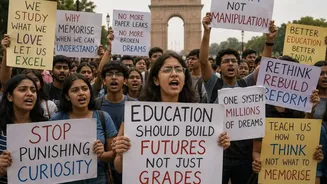






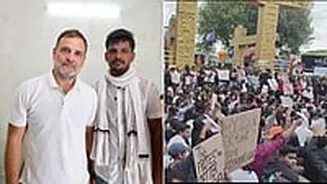

The images from Delhi’s CJP protest will be remembered for more than the politics surrounding them. They will be remembered because they challenged almost
every stereotype about Generation Z. This is the generation often accused of being glued to their phones, unwilling to commit and too quick to complain. Yet thousands of young people turned up day after day, standing for hours in the heat and humidity, making placards by hand, organising through social media, facing tear gas, water cannons and lathi charges and refusing to let the conversation around education die. Whether one agreed with every slogan or every political demand is beside the point. What emerged from the protest was something much bigger... India’s youngest adults no longer see education merely as a pathway to a degree, they see it as a question of fairness, accountability and the country’s future. Speaking to students across schools and universities, along with educators and experts, one thing is clear that their demands are not radical but remarkably practical. They are asking for an education system that prepares them for life rather than simply for examinations. “Why are we forced to become average at everything?” Perhaps the strongest criticism came from 21-year-old DU student Riya Singh. “We are taught in such a structured manner where everyone is supposed to study everything, not realising that we all have different strengths and weaknesses. Instead of strengthening our strengths, we spend years trying to fix our weaknesses. Our books need reform. Our learning should be more expansive and we should get a chance to become better at what genuinely interests us. Why don’t we evolve?” India’s schooling system continues to reward breadth over depth. A student exceptional at biology may spend years struggling through advanced physics. An artist spends precious classroom hours preparing for mathematics examinations that may never again be relevant to their career. A gifted programmer memorises coding syntax on paper instead of building software. The message Gen Z is sending is simple: stop treating every student as if they are identical. One Class 12 student perhaps captured the frustration of an entire generation. “I don’t believe the education system is evolving at all. Society is resistant to change. Because we believe we are already the best, we refuse to accept that parts of our system are flawed. Anyone who points this out is labelled anti-national. Education should become more job-focused and understanding-based. Today it is excessive rote memorisation. Students studying computer science barely code, they write code on paper. A biology student cannot become a surgeon by memorising textbooks. A law student cannot defend a client simply because they can recite the Constitution.” The criticism is difficult to dismiss. In too many classrooms, examinations reward reproduction instead of reasoning. Curiosity often becomes a distraction instead of an asset. Students learn what to think rather than how to think... because when marks become the only measure of success, innovation becomes an unnecessary luxury. Keshav Agarwal, President-Educators Federation believes students should be allowed to identify their strengths much earlier and to be honest, his recommendations are difficult to argue against. "Allow students to choose streams by Class 8 instead of waiting until Classes 10 or 11. Make internships meaningful and credit-bearing instead of decorative additions to a résumé. Regularly update curricula with industry participation instead of revising them once every decade. Bring vocational education, financial literacy, communication and life skills into mainstream schooling instead of treating them as secondary options." Today Gen Z is asking for an education system that measures capability instead of memory. We cannot reform education without reforming teaching. Wing Commander Virendra Prakash (Retd), who has participated in recruitment and selection processes, believes the problem begins much earlier. "Students should be allowed to pursue subjects aligned with their interests from Classes 8 or 9. Doing so would reduce academic burden while creating space for music, sports, art and other disciplines that remain undervalued despite their importance." However, his greatest concern lies elsewhere. “The worst experience was during a teacher selection process. Out of 40 candidates, nearly 30 were not even fit for a peon’s job. Only four were actually good enough to teach. There is a widening gap between qualifications and competence. Degrees have multiplied but skills have not." The solution he offers is of investing in teachers. "No education reform can succeed without investing in teachers. Better training, stronger accountability and significantly improved salaries are not optional, but foundational. Even India’s premier institutions continue to struggle with faculty shortages. We cannot aspire to world-class education while failing to attract and retain world-class teachers." Why should I study Physics for NEET? Andrea Lallianhlui, a student of DPS RK Puram from Mizoram, questioned one of India’s most accepted educational assumptions. “If JEE students can drop biology, why can’t NEET students drop physics?” She says that aspiring doctors would benefit far more from advanced biology, chemistry and biochemistry than from solving physics questions that are as difficult or even more difficult than those faced by engineering aspirants. She asks why should future doctors lose medical seats because they struggle with physics despite excelling in biology? "If medicine requires physics, should engineering entrance examinations equally require advanced biology?" She does not ask that the examinations be made easy, she wants that they should study subjects that remain relevant to the profession students are preparing for. If there was one issue that united every student I spoke to, it was the demand for examinations that are beyond manipulation. Every leaked paper tells an honest student that months and years of hard work can be undone by someone who had access to the questions beforehand. It creates two classes of candidates: those competing on merit and those competing with an unfair advantage. That is why students are demanding something much bigger than harsher punishment and accountability after a leak occurs. They want an examination ecosystem that is designed to make leaks nearly impossible. Experts ask why are there so many human touchpoints in the examination process? Why can't we cut down this chain so there are very few who are involved, through strict audit systems and technology. We can have secure digital encryption, decentralised question paper generation, blockchain-backed audit trails, biometric access controls, limited-access printing and real-time monitoring - they can all reduce the scope for human interference. Much has been written about Gen Z’s impatience, perhaps impatience is exactly what education reform requires. This generation is questioning why memorisation is valued more than understanding. Why entrance examinations often reward test-taking strategy over aptitude. Why students cannot specialise earlier. Why internships and vocational skills are still seen as optional. Why practical learning remains an afterthought. Why employability remains disconnected from education. Why paper leaks continue to recur despite repeated promises of reform... and why accountability appears only after public outrage. Those are not impossible demands.