







What is the story about?
Polls in Israel closed at 10 p.m. on Tuesday, and the first exit polls suggest the question of who will lead the country next could take days to answer.
The three main exit polls show no clear winner and no obvious way for either Prime Minister Benjamin Netanyahu or his opponents to form a government. A repeat election is now a real possibility.
What the exit polls show
Channels 11, 12 and 13 all projected that Netanyahu’s supporters would win 50 of the Knesset’s 120 seats. They gave his Jewish-led opponents 52 or 53 seats.His Likud party is projected to be the largest, with 24 or 25 seats. That is down from the 32 it holds now, but ahead of the 21 to 23 seats projected for Gadi Eisenkot’s Yashar party. Netanyahu’s late push seems to have lifted Likud, but at the expense of his coalition partners.
The biggest surprise is the Arab parties, projected to win 17 or 18 seats. That would be a record for them, up from 10 today, even though they represent about a fifth of the electorate.
Three other exit polls were kinder to Netanyahu:
- Channel 14, which strongly backs him, gave his bloc 60 seats, the opposition 43 and the Arab parties 17.
- i24 News, also pro-Netanyahu, gave his bloc 55, the opposition 49 and the Arab parties 16.
- Channel 16, a new network, gave his bloc 53, the opposition 51 and the Arab parties 16.
A record turnout
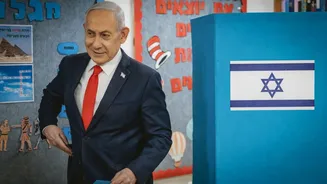
The vast majority of eligible voters cast ballots. Turnout stood at 77.7% as of 10 p.m., or 5,695,682 people, the committee said. At the same point in 2022 it was 70.6%. It is the highest turnout at that hour since 1999.Why nobody can claim victory
Israelis vote for parties, not candidates. The 120-seat Knesset is filled through proportional representation, and a party must win at least 3.25% of the national vote to get any seats. A government needs 61 seats.If the main exit polls are to believed, neither side is close to crossing the treshold. The Arab-led parties also oppose giving Netanyahu another term, so about 70 seats are against him. But some Jewish-led opposition parties have ruled out sitting in a coalition with Arab parties. If they keep that promise, the opposition cannot form a government either.
Netanyahu may declare victory because Likud is the biggest party. It is hard to see how he would win over the 11 opposition lawmakers he would need.
Weeks of bargaining
Both sides are almost certain to ask President Isaac Herzog for the first chance to form a government. His role is largely ceremonial, but he will meet all party leaders and ask the one who looks most likely to succeed to try. That person gets up to six weeks, and if they fail, others may get a turn.Small parties gain a lot from this process, since they can supply the votes that tip the balance. Larger parties often tempt them with Cabinet posts, budgets or policy promises.
Netanyahu and Eisenkot have both ruled out partnering with Arab parties. Still, those parties could help Eisenkot lead a minority government by backing him from outside the coalition, or by abstaining in the vote to install the new government.
What if no one can govern?
If every effort fails, Israel would hold another election within a few months. Netanyahu’s government would stay on as a caretaker. Public services would continue as normal, but it would not have the authority to make major policy changes.Another vote might not fix the deadlock. From 2019 to 2022, Israel held five rounds of voting, and Netanyahu was in office for the first two years of that stretch. After three years of war and a bitter campaign, voters have been left with more uncertainty, not less.