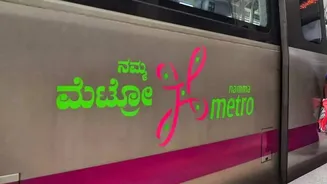

In a major relief for commuters between Bengaluru and Tumakuru, the Bangalore Metro Rail Corporation Ltd (BMRCL) has approved a Rs 1.2-crore deal for the metro
expansion. Once operational, the proposed metro is expected to facilitate around 15,000 passengers per hour in one direction. Tumakuru, located about 69 km from Bengaluru, is increasingly emerging as a potential industrial suburb, making this expansion particularly significant. Officials said the tender has been awarded to Hyderabad-based Aarvee Engineering Consultants for preparing a detailed project report (DPR), reported The Times of India. The BMRCL has given a five-month deadline for submitting the DPR. The tender was floated last month and closed on November 20. Once the DPR is finalised, it will be sent to the central government for approval. With the formal start of DPR preparation, the Madavara–Tumakuru Metro project has entered a critical phase, even as some transport experts caution that metro systems are typically designed for intra-city travel rather than long suburban corridors. Also read: Bengaluru Namma Metro guide: All lines, routes & stations at a glance for commuters
Why the Project is Important
The push for a metro link has gained momentum as Tumakuru develops as an industrial suburb of Bengaluru. Industry bodies, political leaders, and government officials have argued that a metro extension could boost economic activity and ease commuter movement significantly.
Key Features
Currently, the Green Line of Namma Metro runs from Madavara to Silk Institute, spanning 33.4 km with 31 operational stations.
The proposed extension will start near the Bangalore International Exhibition Centre at Madavara, passing through Neelamangala, Dabaspete, and Kyathasandra, before terminating at Tumakuru.
The corridor is planned with 25 elevated stations.
Namma Metro, operated by the Bangalore Metro Rail Corporation Limited (BMRCL), is the city’s rapid transit system connecting major residential, commercial and IT corridors. As of 2025, the network has multiple operational lines, with further extensions under Phase II and Phase III. Services run across elevated, underground and at-grade stretches, depending on the corridor.