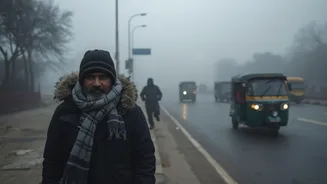

Weather conditions in Delhi are expected to worsen in the upcoming days, as the India Meteorological Department (IMD) has issued an orange alert for Sunday
(December 21) and a yellow alert for the day after. Moreover, the city experienced its first cold wave of the season on Saturday, recording its coldest December day this year as the maximum temperature plunged to 16.9 degrees Celsius. Delhi Environment Minister Manjinder Singh Sirsa on Saturday also warned of worsening weather conditions in the coming days. The temperature is likely to drop to 8 degrees Celsius on Sunday, with a thick layer of fog across the city. The IMD has forecasted dense to very dense fog across the capital.
Delhi Weather Today
Today, maximum temperatures at Safdarjung and Palam dropped by over 5 degrees Celsius, compared to Friday, according to the IMD data.
Earlier today, the city woke up to dense fog, with reduced visibility as the capital was put on orange alert. The alert color codes used by IMD are green (no advisory), yellow (be aware), orange (be prepared), and red (take action).
On Friday, the met department sounded a red alert for Delhi, warning that fog may disrupt operations at some airports and affect highways and railway routes.
Also Read: Delhi Pollution: How To Check Real-Time AQI Using Google Maps, Step-By-Step Guide
Delhi AQI
The overall Air Quality Index (AQI) in Delhi currently stands at 384, with several areas witnessing even more severe pollution levels. The weather department explained that “very dense fog” is recorded when visibility drops to between 0 and 50 metres, while visibility between 51 and 200 metres is classified as “dense”.
Several parts of the city reported alarmingly high pollution levels. According to the Central Pollution Control Board (CPCB), Sarai Kale Khan recorded an AQI of 428, while Akshardham stood at 420. Rao Tularam Marg logged an AQI of 403, and the Barapullah flyover area recorded 380. Other major hotspots included Anand Vihar at 428, Ashok Vihar at 407, and the ITO area at 429, placing large swathes of the capital firmly in the ‘severe’ category.