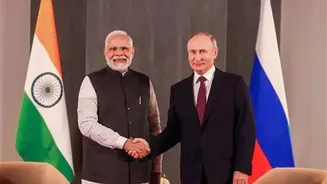









Russian President Vladimir Putin's two-day state visit to India on December 4-5 has sparked global speculation about shifting alliances amid the Ukraine
conflict. However, a fresh analysis from Jefferies suggests it's less about Delhi cozying up to Moscow and more about India's unyielding commitment to strategic autonomy, said a TOI report. In his influential weekly newsletter GREED & fear, Christopher Wood, Global Head of Equity Strategy at Jefferies, decodes the trip as a clear signal: Prime Minister Narendra Modi's government is prioritizing independence over imperial pressures. "Putin's visit does not mean that Delhi is on Russia's side. What it does mean is that the Modi Government is sending the message that it maintains its non-aligned status and is not going to allow itself to be pushed around serving the imperial interests of other powers," Wood wrote, emphasizing India's refusal to be a pawn in great-power rivalries. The Visit in Context: From Kremlin Critique to Summit Solidarity Ahead of the trip, Putin addressed Indian journalists at the Kremlin, framing the Ukraine war as originating from the 2014 Maidan Revolution—a "coup" in Moscow's view. This narrative starkly contrasts with Western media's portrayal of Putin as a cartoonish villain, akin to Austin Powers' Dr. Evil, Wood noted. Yet, in Delhi, the tone was one of pragmatic partnership, not ideological endorsement. The visit marked the 23rd India-Russia Annual Summit, hosted at Modi's invitation. Key highlights included: Reaffirmation of Ties: The leaders celebrated the 25th anniversary of the 2000 Strategic Partnership Declaration, first inked during Putin's earlier visit. They hailed the relationship as a "time-tested" anchor for global stability, built on mutual trust and respect for core interests. Ukraine Stance: Modi reiterated India's call for an immediate end to hostilities, advocating dialogue and diplomacy for a lasting resolution. He offered India's support in mediation efforts, underscoring New Delhi's balanced role as a voice of the Global South. Economic and Strategic Focus: Discussions emphasized a "contemporary, balanced, mutually beneficial" partnership resilient against global uncertainties. Priorities included unlocking trade potential, defense cooperation, and energy security—vital as India sources discounted Russian oil amid Western sanctions. The joint statement underscored shared responsibilities as major powers, committing to "equal and indivisible security" and fostering ties across defense, space, nuclear energy, and trade. With bilateral trade hitting $65 billion in 2024-25, the summit aimed to diversify beyond energy into AI, green tech, and Arctic exploration. Broader Signals: India's Diplomatic Tightrope Wood's take aligns with Modi's "multi-alignment" doctrine—engaging the West, Russia, and China without exclusivity. The visit follows India's hosting of the G20 in 2023 and its push for BRICS expansion, positioning Delhi as a bridge-builder in a polarized world. Critics in the US and Europe may see it as soft-pedaling on Ukraine, but for India, it's about safeguarding 1.4 billion citizens' interests: affordable energy, food security, and tech transfers. As Putin praised India's "unity in diversity" as a model for large nations, the trip subtly rebuffed isolation attempts. In Wood's words, it's Delhi flexing its foreign policy muscle—non-aligned, not neutral, and decidedly not dictated. This evolving Indo-Russian dynamic could reshape Eurasian geopolitics, offering lessons for a multipolar order. As 2025 unfolds, watch for follow-through in joint ventures that blend Moscow's resources with India's innovation.