









United States (US) President Donald Trump's newly announced peace deal with Iran, set to be formally signed on June 19, has triggered its first visible
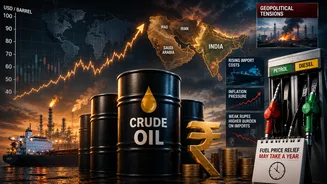
impact on global oil markets. Brent crude, which had surged past $126 a barrel since the conflict began on February 28, plunged to $83 within hours of both sides confirming the agreement. The fall brings early relief to a global economy hit by months of war-driven energy costs. But for Indian consumers, it will not mean immediate savings at the fuel pump, economists told Times Now Digital. Madhavi Arora, Chief Economist, Emkay Global said, "This announcement was thus nearly inevitable – but our physical oil market analysis suggests that price risks are tilted to the upside in the short-term before any relief arrives." "While Brent prices have fallen below USD 85/bbl on the announcement, our assessment of oil market suggests a material risk that prices slowly grind towards and above USD90/bbl in the coming weeks – due to supply normalization delays and return of pent-up demand," she said. Also Read: US-Iran Peace Deal: From Oil To FMCG, Which Sectors To Benefit? On the question about by when the fuel prices can see some relief, Arora said, "prices should correct meaningfully beyond 1HFY27 and fall to USD70/bbl by end-FY27. With 1HFY27 likely to see elevated oil prices, we maintain FY27E Brent forecast at USD90/bbl."
India to get relief on import bill
As the crude oil prices ease further, India's import bill will decline and narrow the trade and current account deficits.
Arun Kailasan, Research Analyst, Geojit Investments Limited said, "A sustained decline in crude oil prices to $70 remains plausible but is contingent on the US–Iran deal, the continuation of free flow of oil through the Strait of Hormuz, and OPEC+ maintaining supply levels. For India, which imports nearly 90% of its crude, such a move would be materially positive."
"Lower oil prices would reduce the import bill, narrow the trade and current account deficits, ease pressure on the rupee which has already strengthened as crude price fell to around $83 amid easing geopolitical risk expectations, and help moderate inflation across sectors such as transport, manufacturing, FMCG, and construction. It would also improve fiscal flexibility for the government and RBI, support consumption, benefit oil marketing companies, and provide a tailwind to sectors that are sensitive to crude-linked costs," he said.
The demand and supply of oil:
Explaining further the demand and supply of the crude oil once the Strait of Hormuz normalises, Madhavi Arora, Chief Economist, Emkay Global said, on the demand side, the collapse in Chinese oil imports (down 50% in June against February) had also been a large buffer. These will also return to the market as SoH reopens and Chinese commercial inventories begin drying up.
"There will be inventory restocking elsewhere too, with OECD commercial (and strategic) inventories at multi-year lows. Global oil demand will remain higher than supply in 2026, with an oil glut only materializing in 2HFY27 and beyond," she said.