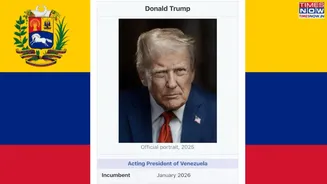








The phrase 'Acting President' came to light when the US President Donald Trump declared himself as the 'Acting President of Venezuela' in a post on social
media platform, Truth Social. While this created buzz all over the world, this particularly becomes important for UPSC Civil Services (CSE) aspirants who plan to appear for the UPSC CSE Prelims 2026 exam on May 24, 2026. What does Trump's post mean? When Donald Trump refers to Venezuela’s leadership on Truth Social, he is reviving the U.S. position taken during his presidency (2017–2021), when the United States rejected Nicolás Maduro’s legitimacy, and recognised Juan Guaidó as the “Acting President of Venezuela” (2019). This comes a few days after the US forces captured the Venezuela President. Through this post, he is also trying to paint Venezuela as a failed socialist state, and probably a symbol of authoritarianism and electoral manipulation. Trump’s Truth Social remarks can create an “acting/interim president” without domestic control. What does 'Acting President' mean? The phrase 'Acting President of Venezuela' refers to a situation where a political leader claims/ assumes or is given the powers of the presidency temporarily. This usually happens due to a constitutional crisis, disputed elections, or absence of a legitimate president in cases of sudden death or imprisonment. In this case, it is due to sudden capture of Nicolás Maduro. Did Venezuela Have an 'Acting President' before this?
- In 2019, Venezuela faced a legitimacy crisis after President Nicolás Maduro’s re-election was widely alleged to be unfree and unfair.
- The opposition-controlled National Assembly declared Maduro’s presidency illegitimate.
- Based on constitutional provisions, Juan Guaidó, then Speaker of the National Assembly, declared himself Acting President.
Key Terms for UPSC
- De jure authority: Legal or constitutional legitimacy (claimed by Acting President)
- De facto authority: Actual control over state machinery (held by Maduro)
- Constitutional crisis
- Recognition of governments (important in International Relations)
Why Is This Important for UPSC?
- Frequently asked in Prelims (Polity + IR) as a current affairs concept.
- Useful for Mains GS Paper II (International Relations, democracy, legitimacy).
- Illustrates issues like:
- Election legitimacy
- Constitutional mechanisms
- Foreign intervention and diplomacy
Trump's post UPSC relevance:
This linkage helps you understand:
- How foreign leaders’ statements influence international legitimacy
- The difference between:
- De jure authority (constitutional claim – Guaidó)
- De facto authority (actual control – Maduro)
- How social media diplomacy (Truth Social, X, etc.) increasingly shapes global narratives
Trump’s posts show that recognition is political, reversible, and interest-driven, a key theme in GS Paper II (IR).
5 UPSC Prelims 2026 Practice Questions
Q1. The term “Acting President of Venezuela” primarily emerged due to which of the following?
A. Military coup
B. Foreign invasion
C. Disputed presidential elections
D. Economic collapse
Answer: C
Explanation: The crisis arose after disputed elections questioning Maduro’s legitimacy.
Q2. Which Venezuelan institution’s head declared himself Acting President in 2019?
A. Supreme Court
B. National Electoral Council
C. National Assembly
D. Armed Forces
Answer: C
Explanation: Juan Guaidó was Speaker of the National Assembly.
Q3. In international relations, recognition of an “acting president” mainly reflects which principle?
A. Collective security
B. Non-intervention
C. De facto sovereignty
D. Recognition of governments
Answer: D
Q4. Which of the following best explains why Juan Guaidó lacked effective control despite international recognition?
A. Absence of constitutional backing
B. Control of military and bureaucracy remained with Maduro
C. UN sanctions against the opposition
D. Public referendum rejected his claim
Answer: B
Q5. Statements by foreign leaders on platforms like Truth Social regarding Venezuela best illustrate which emerging concept in international relations?
A. Hard power diplomacy
B. Track-II diplomacy
C. Digital or social media diplomacy
D. Cultural diplomacy
Answer: C
For feedback or story ideas, reach us at timesnoweducation@timesgroup.com