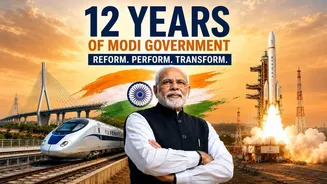








On Wednesday, June 10, the Narendra Modi government completes 12 years in office - long enough for its defining promises to be judged not by intent, but
by what they have actually delivered on the ground. It is also the longest unbroken tenure of any non-Congress prime minister in India’s history. Across three terms, the NDA government has organised its governance around a few consistent ideas: welfare routed directly to the beneficiary, a state-built digital backbone, an assertive national security posture, and the framework Modi returns to most often - “reform, perform, transform”. The raw numbers are hard to dispute. Crores of bank accounts opened, toilets built, homes sanctioned, vaccines administered, and a payments system the rest of the world now studies. What remains contested is the interpretation: supporters see a state that fundamentally rewired how it reaches its citizens, while critics argue much of it repackages older welfare ideas with sharper branding and better delivery. Both readings can hold at once. What is harder to argue with is the scale of the shift - India in 2026 runs on systems that barely existed in 2014. Here is a look at the 12 achievements that have come to define 12 years of the Modi government. 1. Direct Benefit Transfer (DBT): DBT is one of the Modi government's signature reforms. It transferred subsidies directly into the bank accounts linked to Aadhaar. The government states that DBT has reduced the scope of leakages worth thousands of crores and removed intermediaries from welfare delivery. The problem of the "ghost beneficiary" - once endemic in ration and LPG systems - has been systematically and significantly reduced through digitisation, the Centre claims. 2. Jan Dhan Yojana: Jan Dhan Yojana was launched in 2014. It has now crossed into tens of crores of accounts, bringing financial inclusion to rural and low-income households. What began as "zero balance accounts" became the backbone of the DBT. Critics may have called them "sleeping accounts", but they became active during the COVID-19 relief transfers. 3. Swachh Bharat Mission: Under the flagship Swachh Bharat Mission, over 10 crore toilets were built, drastically improving sanitation coverage in rural India. As per government reports, the mission has enabled near-universal access to toilets today. The bigger impact was perhaps the symbolic one - it made open defecation a political talking point instead of something to be swept under the rug. 4. PM Awas Yojana: Under PMAY, millions of houses have been sanctioned and built for the urban and rural poor. The idea of PMAY was simple - shift from "temporary shelter policies" to ownership-based housing. For many families, this was the first time they saw a legal, pucca address attached to their name. 5. Ayushman Bharat: Ayushman Bharat is the world's largest government-funded health insurance scheme that offers coverage up to Rs 5 lakh per family. It aims to reduce the astronomical health expenses for the poor. It may still be unevenly implemented but it is widely seen as a key government intervention in India's health architecture. 6. UPI Revolution UPI is perhaps India's most visible reform globally. UPI transformed India into one of the world's largest real-time digital payment ecosystems. From roadside tea stalls to high end malls, QR codes have become the new currency. Even skeptics have admitted: India didn't just go digital. It skipped a generation of financial infrastructure. 7. GST: One Nation, One Tax The Goods and Services Tax replaced India's multiple indirect taxes with a single national tax system. While the rollout was chaotic, it ultimately created a unified market. Trucks no longer wait at state borders as long as they once did - which is a small logistical detail with massive nationwide economic implications. 8. Infrastructure Boom India has seen a record boom in highway construction, expansion of expressways and rail electrification. The Ministry of Road Transport has often highlighted the near double pace of highway construction as compared to earlier decades. Some of the major projects include the Delhi–Mumbai Expressway, the Purvanchal Expressway, which connects Lucknow to eastern parts of the state, and the Bundelkhand Expressway. Other major projects include the Ganga Expressway (under construction), which is set to become one of the longest expressways in India, connecting western and eastern Uttar Pradesh; the Bangalore–Chennai Expressway and the Ahmedabad–Dholera Expressway, which is being built to support the upcoming Dholera Special Investment Region. 9. Criminal Justice Reforms The replacement of colonial-era laws - the Indian Penal Code, Code of Criminal Procedure and Indian Evidence Act - with the Bharatiya Nyaya Sanhita, Bharatiya Nagarik Suraksha Sanhita and Bharatiya Sakshya Adhiniyam represented one of the most significant legal reforms in decades. The government argued that the new laws modernised India's criminal justice system and improved efficiency through greater use of technology and stricter timelines. 10. Digital India India has undergone a digital revolution as far as public services are concerned. From DigiLocker to e-governance platforms, today certificates, payments, and applications largely bypass physical paperwork. This revolution may have been less visible than flyovers, but arguably more transformative and impactful. 11. COVID-19 Response And Vaccine Diplomacy During the Covid pandemic, India executed one of the world's largest vaccination drives nationally. It also launched Vaccine Maitri under which it exported vaccines globally, particularly in the Global South. This was a moment of high-stakes governance for the Modi government. It combined crisis management with geopolitical outreach, and quickly garnered international attention. India supplied vaccines to partner countries across Asia, Africa, Latin America and the Caribbean. WHO Director-General Dr Tedros Adhanom Ghebreyesus described India's vaccine production capacity as "a major global asset" in the fight against the pandemic. 12. Welfare Expansion And Food Security Schemes like PM Garib Kalyan Anna Yojana provided free food grains to over 80 crore people during and after the pandemic period. For many households, government ration shifted from a monthly supplement to a survival guarantee. 12 Years On: A State That Changed Its Operating System Twelve years on, the Modi government's development ideology is clearly visible in infrastructure - digital systems, welfare delivery networks and centralised service mechanisms such as DBT, UPI and DigiLocker. In pure governance terms, India today runs on systems that barely existed in 2014 - instant digital payments, direct transfers, massive sanitation coverage, and a nationalised welfare architecture. As Prime Minister Narendra Modi has often summed up the approach: "Reform, perform and transform."