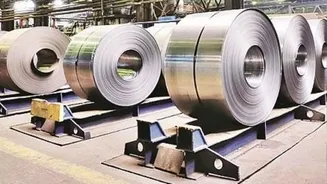







India's steel sector is poised for significant growth over the next decade, with demand projected to rise to 250-280 million tonnes per annum by 2035.
However, meeting this demand will require substantial capacity expansion, with investments estimated at as much as 350-400 billion dollars, according to McKinsey. The report stated that India's steel demand could further increase to 320-350 million metric tonnes per annum by 2040. Highlighting the growing significance of the sector in India's economic development, the report stated steel contributes around 2 percent of the country's GDP and supports approximately 2.8 million direct and indirect jobs. "Driven by construction and infrastructure, steel demand is projected to reach 250 to 280 million metric tons per annum by 2035, and around 320 to 350 million metric tons per annum by 2040." Infrastructure and construction currently account for around 65-68 percent of domestic steel consumption, reflecting the sector's close link with India's broader economic and industrial expansion. India's crude steel capacity reached approximately 233 million metric tonnes per annum in 2026, compared with around 210 million metric tonnes in the previous year. The government has outlined a longer-term capacity target of 600 million metric tonnes per annum by 2047, the report noted. To support the expansion, steel producers have announced projects that are expected to add approximately 60-70 million metric tonnes per annum of capacity over the next five to 10 years. "Building the capacity additions envisaged through 2047 is estimated to require investment ranging from approximately $350 billion to $400 billion," the report said. It added that steelmakers could deploy this capital over the next two decades while expanding existing facilities, developing greenfield capacity and investing in supporting equipment and infrastructure required to operate new plants. However, McKinsey cautioned that expansion will require more than setting up new plants. Steelmakers will need to secure adequate supplies of iron ore, coking coal and scrap, while developing supporting infrastructure, equipment manufacturing and engineering capabilities. "The scale of capacity expansion also has implications beyond steelmaking assets," the report said, noting that parallel growth in mining output, logistics networks, raw material processing and downstream value addition would be necessary. The report also flagged raw material dependence as a key challenge for the expansion. India imported around 95 percent of its coking coal requirement in fiscal year 2025, exposing steelmakers to international supply and price volatility. The report also underlined the importance of balancing capacity growth with sustainability, noting that the long operating life of steelmaking assets could have implications for the industry's emissions profile well beyond 2050. "The long operating life of steelmaking assets means that capacity commissioned over the coming decade could remain operational well beyond 2050," the report stated. (With Inputs From ANI)