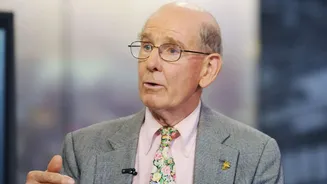









US economist Gary Shilling has warned that a recession in the United States this year is "almost inevitable", citing multiple weaknesses across the economy
and elevated stock market valuations. In an interview with Business Insider, the former Merrill Lynch economist said only a significant boost in government spending or sustained strength in consumer demand could avert a downturn — both of which he considers unlikely. Shilling pointed to several indicators he believes signal growing economic strain. The housing market, he said, remains largely stagnant as expectations of persistently high interest rates deter buyers. While there was a brief rise in home sales when mortgage rates dipped last year, activity has since slowed again as borrowing costs increased. He also highlighted a sharp slowdown in capital expenditure — business investment in areas such as hiring and equipment. Although spending related to artificial intelligence has increased, overall capital expenditure growth has fallen to 3.9% at the end of last year, down from more than 24% during the pandemic. Also Read: US Economy Grows 2% Despite Iran War Oil Shock, But Risks Loom Consumer spending, which accounts for roughly two-thirds of US economic activity, has so far remained relatively stable, growing at about 2% annually. However, Shilling warned this may not last. Americans are facing continued pressure from higher prices, including a recent surge in energy costs linked to geopolitical tensions. Energy prices rose 12.5% year-on-year in March, the largest increase since 2022. At the same time, real disposable income growth has slowed to 0.4% annually — its weakest pace in around three years — while the personal savings rate has fallen to 3.6%. "That's really on very thin ice in terms of income, in terms of people's willingness to spend," Shilling said.
He also expressed concern about stock market valuations, describing them as "very expensive". He pointed to the inflation-adjusted price-to-earnings ratio — known as the Shiller CAPE — which is near levels last seen before the dot-com crash. Other measures, including price-to-sales and price-to-book ratios, are also at record highs.
"A decline of 20% or 30% is no big deal by historical standards," he said. "So I would say that's probably in the cards." While he acknowledged that it is unclear what might trigger such a decline, Shilling said market corrections of this scale often follow periods of excess.
"I've sort of made a career looking for those hidden flaws, and I don't see anything right now that is just screaming for a big sell-off, but that doesn't mean it isn't there," he added.
Shilling has consistently warned of a potential recession and market downturn in recent years, previously pointing to speculative activity in areas such as artificial intelligence and cryptocurrencies as possible risks.