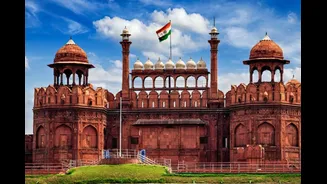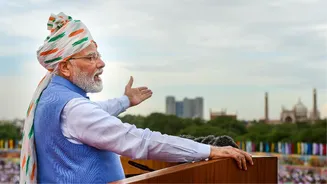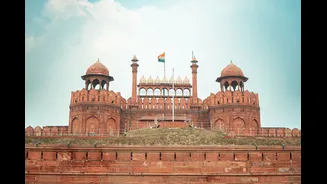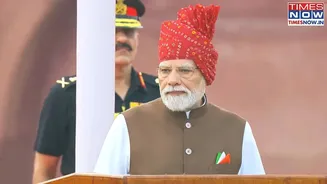








New Delhi: In a first for Independence Day celebrations, 'Vande Mataram' was rendered at the Red Fort complex on August 15, during the 80th Independence Day celebrations.
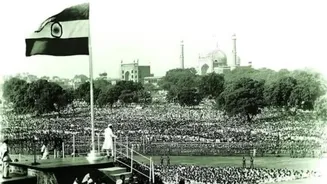
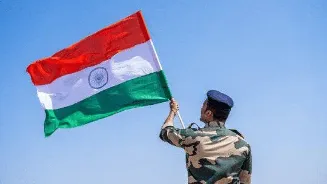
It was followed by the recitation of the national anthem at the grand event. The celebrations marked 150 years of the enduring legacy of the national song, 'Vande Mataram'. Floral decorations on the Red Fort ramparts featured the national flag at the centre, with 'Vande Mataram' written in Hindi on either side. Prime Minister Narendra Modi led the 80th Independence Day celebrations at the Red Fort amid patriotic fervour and tight security arrangements. An Army band played the tune of 'Vande Mataram', while guests present at the venue sang the national song. This was followed by Prime Minister Modi hoisting the national flag and the recitation of the national anthem. After the flag was hoisted, the Tricolour received a 'Rashtriya Salute'. Flower petals were then showered over the venue by two Mi-17 helicopters of the Indian Air Force. One helicopter carried the national flag, while the other carried a flag depicting 'Vande Mataram'.
150 Years Of Vande Mataram
Written in 1875 by Bankim Chandra Chatterjee, 'Vande Mataram' became a rallying cry during India's freedom movement. The Constituent Assembly adopted it as India's national song in 1950.
The government launched a year-long celebration last November to mark 150 years of 'Vande Mataram'.
'Vande Mataram' was initially composed independently and was later included in Chatterjee's novel 'Anandamath'. It was first sung by Rabindranath Tagore at the 1896 Congress Session in Calcutta, now Kolkata.
The chant 'Vande Mataram' was first used as a political slogan on August 7, 1905, according to a government note titled '150 Years of Vande Mataram: A Melody That Became a Movement', shared on November 6 last year.
'Vande Mataram' was first published in the literary journal 'Bangadarshan' on November 7, 1875. Chatterjee later incorporated the hymn into 'Anandamath', published in 1882. The government note said it was set to music by Tagore.