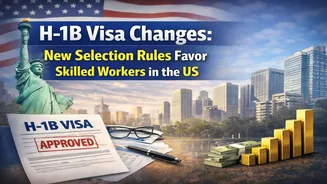








The US Department of Homeland Security (DHS) rolled out a new H-1B visa selection system last year, replacing the earlier random lottery with a wage-based
model. According to a Bloomberg Law report, this shift has significantly improved selection rates for highly skilled foreign workers. Data from several immigration firms suggests that in some cases, selection chances have crossed 50%, a sharp rise from the roughly one-in-three odds seen in previous years. The Bloomberg Law report also cites Kelli Duehning, a partner at the business immigration law firm BAL, who noted that for some of their clients, selection rates went beyond 60%. “The $100,000 fee was really, it felt like a big delta,” she said. “That six-figure fee had already blocked almost all international recruiting through the programme by universities and hospitals. It led tech firms and other companies subject to an annual visa cap to also opt out of hiring from abroad, which accounted for four in 10 new H-1B employees in recent years. But it was a boon to workers already in the US whose companies opted to enter them in the annual visa lottery,” the report cited. In September last year, the Trump administration introduced a $100,000 registration fee for H-1B visa applicants. According to immigration firms quoted by Bloomberg, the higher cost reduced the number of applicants, which in turn improved the chances of selection this year. The report stated that while the $100,000 fee played the biggest role in influencing the lottery, changes in the job market and evolving policies around the programme also helped shape the overall pool of applicants.
Shift from Lottery to Merit-Based Selection
The H-1B visa system is set for a major shift, moving away from the traditional random lottery to a more structured selection process. Earlier, visas were allocated through a lottery since applications far exceeded the annual cap of 85,000.
Under the new approach, selection will no longer depend purely on luck. Instead, the US Department of Labour will set salary levels for applications, and candidates with higher pay offers will have an edge.
This revised system is scheduled to take effect from February 27, 2026, ahead of the upcoming H-1B registration cycle.
Also Read-US Sees 6.9% Drop in Indian Student Numbers Amid Tighter Visa Rules: Government Informs RS