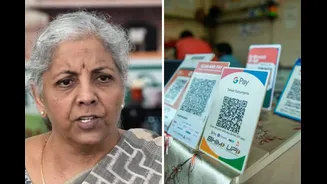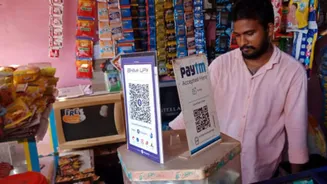








Union Finance Minister Nirmala Sitharaman has clarified that the newly announced Merchant Discount Rate (MDR) on select UPI transactions will not be passed
on to consumers. She said the mechanism will be imposed on operators and will not be passed on to customers. Finance Minister's clarification comes amid the ongoing confusion over the MDR to be charged on the UPI transactions. Under the framework, effective October 15, 2026, a 0.4% MDR will apply to specified merchant UPI transactions above Rs 2,000, subject to a Rs 300 cap. Addressing ongoing speculations around the charges, FM blamed the opposition for creating confusion and urged people to remain alert. While speaking to news agency ANI, Sitharaman said she had already addressed the issue in Parliament, stressing that MDR is a charge between payment operators and will not be 'burdened' on UPI users. Sitharaman stressed that MDR is neither a tax nor a cess and that the money collected through it will not go into the Consolidated Fund of India. "It does not apply to transactions below Rs 2,000. It is neither a tax nor a cess; the funds will not be deposited into the Consolidated Fund of India. It is a charge levied by service providers to improve the system and provide better service, not for small transactions. Moreover, it is a charge between operators; it will not be passed on to the consumer. The burden does not fall on the customer,” she said.
What experts say?
On the UPI MDR rule introduced by the government, Harish Kumar, CEO, Quick Heal Technologies said, “The government’s move to keep UPI transactions up to ₹2,000 free, while opening the possibility of charges on higher-value transactions, comes at a time when UPI has become deeply embedded in India’s everyday digital economy. As the value and volume of transactions continue to grow, maintaining consumer trust will be as important as maintaining the convenience and accessibility that have driven UPI’s adoption."
"From a cybersecurity perspective, higher-value digital payments can increasingly become attractive targets for cybercriminals because the potential payoff is greater. However, the risk is not limited to the transaction value alone. Attackers are becoming more sophisticated, using social engineering, impersonation, malicious applications and increasingly AI-enabled techniques to manipulate users into authorising transactions themselves," he added.
Brijesh Agarwal, CEO, Busy Infotech said, “Busy Infotech serves more than 6 lac MSME companies and helps them manage their payments, receivables, accounting, inventory, GST, TDS/TCS and various other compliances. For these small traders, distributors, and manufacturers, UPI has become a vital tool for daily collections, B2B supplier payments, batch invoicing, and working capital management."