







As someone who has worked with over a thousand students navigating their early career decisions, I have learned that the biggest challenge is not getting
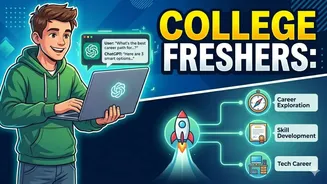
into college. It is knowing how to use those years well. Every year, I meet a new batch of college freshers who arrive with a mix of excitement and quiet panic. The question is no longer just “Which college did you get into?” It has evolved into “What are you going to do with it?” What has changed in the last couple of years is how students are answering that question. The most proactive ones are no longer waiting for seniors, professors, or placement cells to guide them. They are building their own decision-making systems, and increasingly, tools like ChatGPT are at the center of it. One of the most interesting shifts I have seen is in how students evaluate themselves. Earlier, a fresher’s resume was a static document, often built overnight before an internship application. Today, students are benchmarking themselves constantly. They take profiles of seniors on LinkedIn, people who have interned at companies they aspire to, and use ChatGPT to break those profiles down. What skills show up repeatedly? What kind of projects stand out? What is missing in their own story? The outcome is not just a better resume, but a sharper understanding of how the market rewards certain experiences. Preparation for internships has also become far more independent. Instead of relying entirely on mock interviews with peers or mentors, students are simulating real interview environments. They are using ChatGPT to role-play interviewers, ask follow-up questions, and critique their answers. The feedback loop is faster and more consistent. More importantly, it removes the hesitation many freshers feel when asking for help. They practice more because the barrier to practice is gone. Another pattern observed is how students are staying informed. The best freshers are not just consuming information, they are curating it. They use ChatGPT to track industries they are curious about, break down complex trends into simple insights, and connect those insights to their own career decisions. Instead of being overwhelmed by information, they are organising it into something actionable. Over time, this builds clarity, which is often the biggest differentiator in the first year of college. There is also a creative layer emerging. With newer image generation capabilities, students are moving beyond plain text resumes. They are experimenting with visual profiles, project snapshots, and narrative-driven portfolios that are far more engaging. It is not about making things flashy for the sake of it, but about standing out in a way that reflects both effort and thought. For those who go a step further, the ecosystem is expanding quickly. Some students are using tools like Codex to build simple dashboards that track applications or showcase projects. Others are exploring structured learning through initiatives like OpenAI Academy to deepen their understanding. These are not advanced engineers. They are first-year students who are simply more curious and more willing to experiment. The larger point is: ChatGPT is not making decisions for students. It is helping them ask better questions, test their assumptions, and move faster from confusion to clarity. In a world where information is abundant but direction is scarce, that shift matters. The students who recognise this early are not just better prepared for their first internship. They are better prepared to navigate everything that comes after. (Inputs by Abhishek Gulati, Growth and Career Strategist)