





What is the story about?
"This is OUR Hemisphere, and President Trump will not allow our security to be threatened." The above X post by the US State Department - issued just days
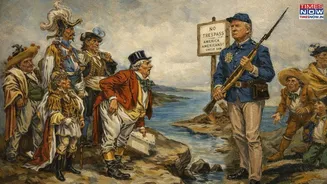
after the Venezuela operation in early January - revived memories of the Monroe Doctrine of 1823. The Monroe doctrine was first articulated in 1823 by President James Monroe to block European interference in the Western Hemisphere. This was not an off-the-cuff reference.
The 'Donroe Doctrine'?
Following the dramatic operation to depose Venezuelan President Nicolas Maduro, Trump unveiled a modern revival of the Monroe Doctrine. He called it the 'Donroe Doctrine'.
Speaking at Mar-a-Lago, Trump said Venezuela under Maduro had hosted "foreign adversaries in our region" and acquired "menacing offensive weapons that could threaten US interests and lives".
"All of these actions were in gross violation of the core principles of American foreign policy, dating back more than two centuries," Trump said. "All the way back, it dated to the Monroe Doctrine. And the Monroe Doctrine is a big deal, but we've superseded it by a lot, by a real lot. They now call it the 'Donroe Doctrine'."
This was not said in passing.
Monroe's portrait hangs near Trump's desk in the Oval Office. In December, Trump marked the doctrine's anniversary by saying his administration "proudly reaffirms this promise under a new 'Trump Corollary' to the Monroe Doctrine".
Soon after, a national security strategy formally laid out that corollary, with a sharp focus on the Western Hemisphere.
To understand what Trump is reviving, one must return to 1823.
In his annual message to Congress, Monroe warned European powers against further colonisation or interference in the Americas. The Western Hemisphere, he said, would be treated as a US sphere of interest.
Over time, that warning became a justification for intervention.
In 1865, the US backed Mexico's Benito Juarez against French-installed Emperor Maximilian. In 1898, Washington went to war with Spain, ending its colonial rule in the region. The US took control of Puerto Rico, Guam and the Philippines, and gained decisive influence in Cuba through the Platt Agreement.
Roosevelt Expands Theory Further
President Theodore Roosevelt expanded the doctrine further. In 1904, he claimed the US had the right to act as an "international police power" to address what he called "chronic wrongdoing".
That idea led to repeated US military interventions in the Dominican Republic, Nicaragua and Haiti within little more than a decade.
Later presidents globalised American intervention. During the Cold War, President Harry Truman spoke of supporting "free peoples who are resisting attempted subjugation".
In Latin America, that logic merged with Monroe-era thinking. It was used to justify actions against Fidel Castro in Cuba and the coups in Guatemala in 1954 and Chile in 1973.
Eduardo Gamarra of Florida International University summed it up succinctly. US strategy, he told NPR, was one of strategic denial. "In the 1800s, that meant Europeans; in the 20th century, especially after World War II, it meant the Soviet Union."
The same logic shaped the 1962 Cuban Missile Crisis. President John F Kennedy ordered a naval quarantine after discovering Soviet missile installations in Cuba, framing them as a violation of hemispheric boundaries.
By 2013, however, the doctrine was declared dead.
John Kerry, then Secretary of State, said "the era of the Monroe Doctrine is over". He argued that the US sought partnerships, not declarations of dominance. "It's about all of our countries viewing one another as equals", Kerry said.
Trump, however, has reversed that position.
Trump's Interventionist Foreign Policy
Though he campaigned on 'America First' and restraint abroad, his second term has been markedly interventionist. He floated acquiring Greenland and the Panama Canal. He ordered strikes on Iranian nuclear facilities. He tightened military pressure on Venezuela for months before Maduro's capture.
After the operation in Caracas, Trump said, "We're going to run the country until such time as we can do a safe, proper, and judicious transition." Secretary of State Marco Rubio later said the US would rely on economic leverage instead.
After Venezuela, Trump Eyes Colombia, Mexico And Iran?
Trump has since threatened action against Colombia and Mexico. He has renewed warnings over Iran, saying if protesters are killed, "America will come to their rescue."
The administration insists this approach protects both security and economic interests. Venezuela's oil reserves. Greenland's strategic value. Trade leverage through tariffs.
Yet doubts remain.
'There's No Trump Doctrine'
John Bolton, Trump's former security adviser, offered a blunt assessment. "There is no Trump Doctrine: No matter what he does, there is no grand conceptual framework; it's whatever suits him at the moment."
What is clear is this: a doctrine born in 1823 has been repackaged for 2026. And once again, the Western Hemisphere is being told where power lies.